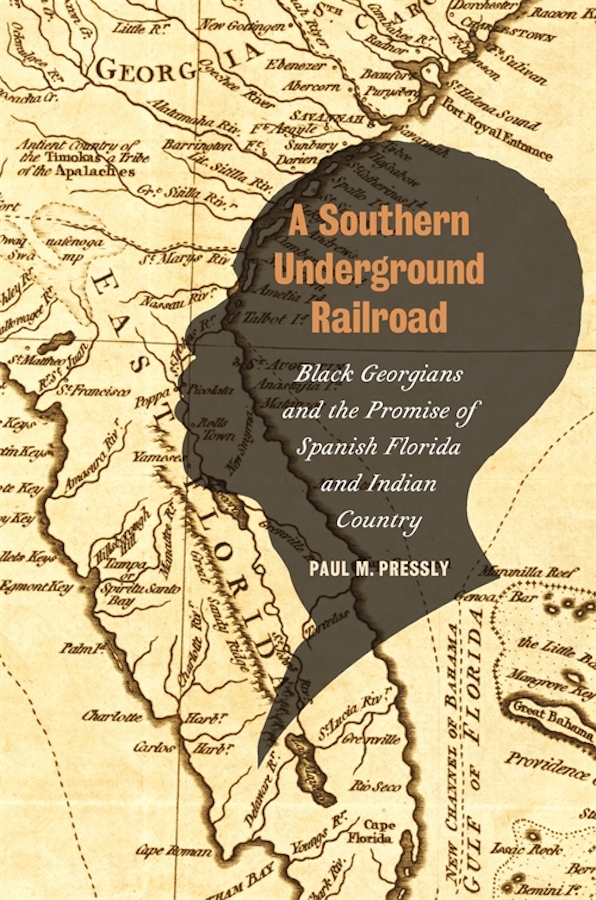
Pressly's exceptionally well researched study works largely from examples. He begins in 1781, with nine individuals on a dock at Ossabaw Island. Led by an expert seaman known as Hercules, the nine freedom-seekers sailed one-hundred miles south to St. Augustine, where they found protection under the British military. Pressly pieces together this story from notices in the Georgia Royal Gazette. By situating a single granular case against broader trends, then alongside corroborating scholarship from elsewhere, Pressly completes a patchwork recovery. The remainder of the book moves chronologically, from the mid-eighteenth century to the Seminole War, when the United States' invasion of a weakened Spanish Florida brought a close to this still-overlooked "underground railroad."
Pressly sets up a tale of two cities, Savannah and St. Augustine, separated by the mazy floodplain of the St. Mary's River. He emphasizes that in negotiating their southern path to freedom, individuals and groups asserted their liberty both apart from white intervention and with full knowledge of broader political movements. "Far from passive individuals," Pressly writes, "they were well aware of the geopolitical landscape, and the enslaved people were ready to seize the moment when the time seemed ripe to make a break for the freedom offered by Spanish Florida to fugitives from British colonies" (12). In chapter two, "The Journeys of Mahomet," Pressly uses the life of an African-born and (presumably) Muslim individual of that name "as a measure of the type of man" (35) who chose maroonage, as well as the "noteworthy presence of women" in a flight that "underscores their determination and courage" (47). Pressly returns to the example of Hercules, who "offers a map for navigating the full spectrum of the landscape for Black people in revolutionary Savannah" (54). Hercules faced any number of options during the Revolutionary conflict, though amidst the disruption, he and other Black fugitives laid the groundwork that would provide freedom for decades to come.
"Entangled Borders" revisits the colonial boundary line of the St. Mary's River during Florida's second Spanish period (1783-1821), when "East Florida and southern Georgia evolved into one large zone of transition," in which "weak central authority" opened the space for "fugitives to find a path forward toward a new life" (76-77). Those escaping bondage often did so in groups, led by a skilled waterman over international boundaries, and the effort required careful planning and fortitude. The Spanish crown had long granted a modicum of rights to free Blacks, and the draw of a more liberated and permeable Florida generated anxiety in what is now the southern United States. Pressly’s chapter, "A Maroon in the Revolutionary South," recounts the "exploits of a man named Titus," whose choices "illuminate several faces of maroonage on the Georgia and Florida coasts and the fluidity of the borders" between them (94). These choices were exceedingly complicated; Titus was a "dancer" (102), having fled Georgia's Ossabaw Island yet remaining close to family and on the fringes of the plantation. His story illustrates a central theme of A Southern Underground Railroad: freedom amidst connection, runaways who were "connected with the realities of the Atlantic world" (111). This should come as no surprise, yet it bears restating: maroonage was complex.