It started auspiciously. President Roosevelt offered critical support. In part, it fit into his dream of modernizing the South; as a staunch public power man, it also fed his vendetta against private electric utilities. FDR hand-picked the first members of the TVA’s three-man board; Lilienthal, a former utilities lawyer, was one. But things soon went downhill. The TVA’s sprawling mission led to increasingly public fights between the three directors, each of whom held a different vision for the agency. The spats resulted in a Congressional investigation of the TVA, after which Lilienthal increasingly took charge, finally becoming the chairman in 1941. Once at the helm, he focused the TVA on its ambitious program of dam construction
The program bore fruit as the first few dams began to control floods and bring electricity to the region. Much of the early bickering was forgotten when the TVA delivered the enormous Douglas Dam in just over a year, with a low accident rate, all in the wartime conditions of 1943. The dam powered factories essential to the war effort, including the then secret Clinton Laboratories (now Oak Ridge National Laboratory), which enriched uranium used in the Manhattan Project.
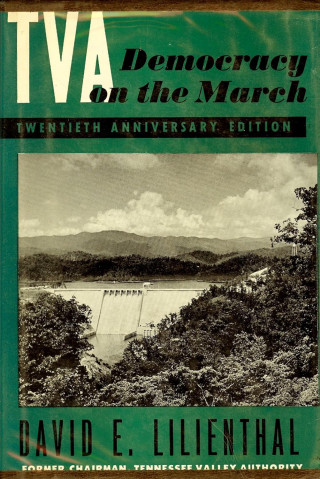
The TVA won widespread public acclaim, and the American people were eager to hear the story of its success. Lilienthal published Democracy on the March in 1944, dedicated to the people of the Tennessee Valley region. As he pondered moving on from his role, he told, in an almost evangelical tone, his narrative of what the TVA meant, and why development mattered.
It is difficult today to imagine the hold Lilienthal once had on the liberal imagination. It is tempting to call him the Ezra Klein of the 1940s, but the comparison is not wholly accurate — unlike Klein, Lilienthal is exciting. A generation of liberals dreamed of living in the world that the TVA was building, and of being the men that Lilienthal challenged them to be.
The author John Gunther spoke for postwar liberals when he called the TVA arguably “the greatest single American invention of this century, the biggest contribution the United States has yet made to society in the modern world.” Although hyperbolic, Gunther’s judgment carried weight; he had just toured the entire United States while writing his masterpiece of Americana, the travelogue Inside U.S.A.
Having surveyed everything the United States had to offer, from the commanding heights of industry to the nascent welfare state, Gunther judged the TVA the fullest embodiment of America’s promise. Liberals like him trusted Lilienthal for two reasons: the soaring rhetoric that cast Abundance as a moral project, and the record of achievement that proved it possible. On both counts, today’s Abundance movement has something to learn from the Tennessee Valley Authority. They could learn it from Democracy on the March – though they should read it with caution. With respect to rhetoric, Lilienthal remains unparalleled in describing prosperity as a fundamentally American value. But he was unreliable at describing the reasons for the TVA’s success, instead portraying the TVA’s self-serving compromises as visionary ideals. Both matter for proponents of Abundance: TVA’s real approach shows how to deliver projects that inspire confidence, while Lilienthal’s language gives people a reason to believe in their importance.