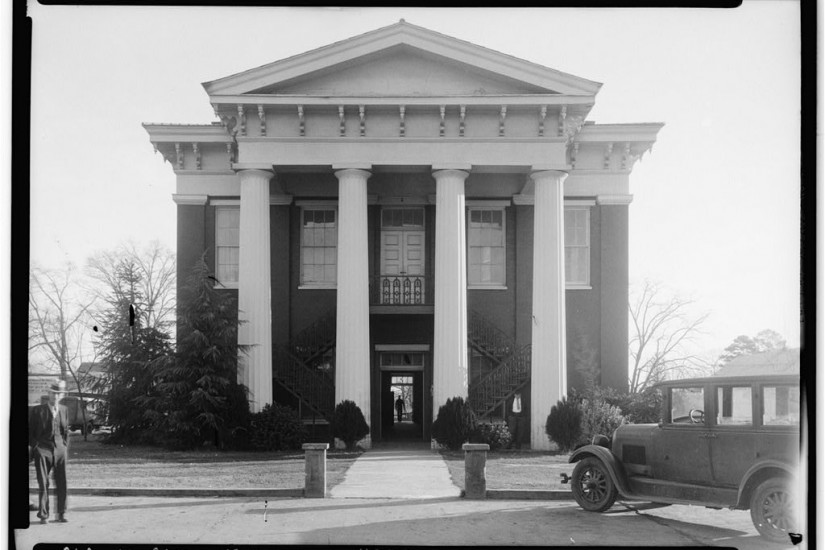
Talk to anyone over the age of 70 in Camden, Alabama, and they can tell you a story about Lummie Jenkins, the sheriff of Wilcox County from 1939 to 1971. According to newspapers across the Deep South, Percy Columbus Jenkins—also known as Sheriff Lummie, Mr. Lummie, or just Lummie—was “a superb raconteur,” a “master psychologist,” and a “modern-day hero.” It was common lore that, unlike other sheriffs in the region, Lummie didn’t need to carry a gun, and he didn’t go prowling for suspects. Instead, he kicked back in his chair at his chinaberry-wood desk, packed his pipe with Prince Albert tobacco, and summoned the guilty parties to the Wilcox County Courthouse in downtown Camden simply by word of mouth. Out of fear or respect, the legend goes, suspects came in of their own accord.
The length of Lummie’s tenure as Wilcox County’s chief law enforcer—eight consecutive terms—broke records in Alabama. And because much of it took place before the dawn of Miranda rights, which were enshrined in law by a Supreme Court ruling in 1966, there are countless stories, some surely truer than others, about the sheriff’s knack for coercing a confession from anyone. Newspapers reported claims that he employed sorcery, mind reading, and dreaded doses of “Truth Medicine”—sips from a glass bottle of Listerine he kept in his office that sported the disclaimer “Will paralyze if you lie.” Lummie had powers, people said, that exceeded those of ordinary lawmen.
You could say that law enforcement was in his blood. His father, P. C. Jenkins Sr., was sheriff of Wilcox County from 1911 to 1914. Lummie was just 12 when he snuck out of school to watch his dad preside over a public execution by hanging in Camden’s town square. “There were so many people,” he later recalled. “It looked just like a show day.”
Wilcox County sits in Alabama’s Black Belt, so named for its rich, dark soil and concentration of Black residents. It’s a place where the legacy of slavery runs deep; immediately before the Civil War, few counties across the South had more enslaved people. The sheriff’s domain comprises the city of Camden, four small towns, and a tangle of hilly two-lane highways and red-dirt roads that weave through the overgrowth of fallen cotton empires and felled pine woods. In 1960, there were some 18,000 residents in Wilcox County, 78 percent of whom were Black. Today, the population is fewer than 10,000 and more than 70 percent of residents are Black. Then as now, Wilcox hovered near the top of the list of the nation’s poorest counties.