
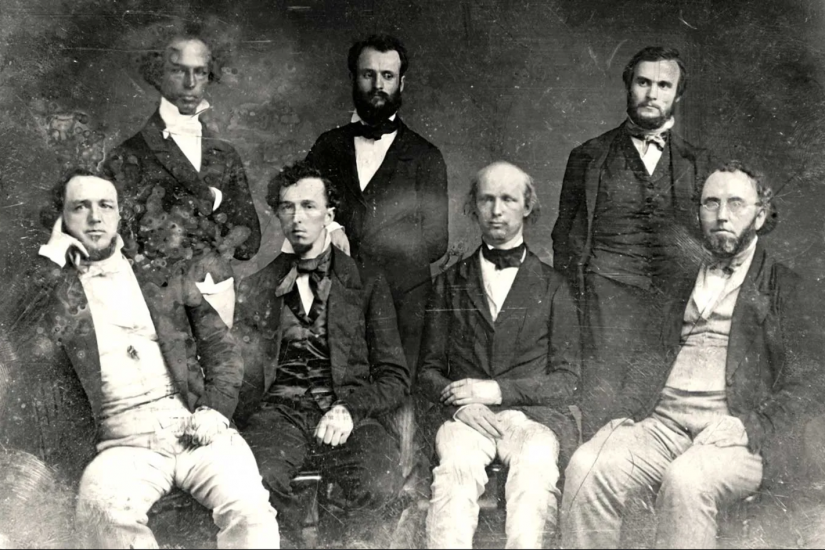
Fowler and Greeley are just two of the seven antebellum reformers that Philip F. Gura profiles in his latest book, Man’s Better Angels: Romantic Reformers and the Coming of the Civil War. The others are George Ripley, William Batchelder Greene, Mary Gove Nichols, Henry David Thoreau, and John Brown. All of them were psychologically scarred, Gura argues, by the awful Panic of 1837, an economic depression precipitated to a great extent by rampant land speculation, inflation, and Andrew Jackson’s decentralization of the US banking system. The results of the panic were devastating: factory shutdowns, pervasive unemployment, widespread hunger, and unremitting misery nationwide.
According to Gura, these seven figures were representative of a broader self-help culture of reform that spread across the United States in the years before the Civil War. Shaken to their core, they each scrambled after various panaceas—some of them pretty weird—to revive the country from its economic stagnation, which they generally assumed had its root cause in the poor physical or mental health of the individual, a being innately virtuous, creative, and capable of spiritual elevation. Hence the “romantic” in the title of his book: These reformers set out to nurture the “better angels of our nature” years before Abraham Lincoln uttered that memorable phrase in his first inaugural speech.
Although his subjects may have been naive, Gura himself is no ingenue when it comes to America’s antebellum culture and its discontents. A distinguished professor at the University of North Carolina, Chapel Hill, and the author of such fine books as American Transcendentalism: A History and Truth’s Ragged Edge: The Rise of the American Novel, Gura is an undisputed expert on literature written in the vexed era before and after the Civil War. Here, in this elegant volume, he provides seven biographical chapters that examine how his reformers dedicated themselves to what he calls “imaginative, if frequently specious, ways for Americans to think about how, by improving certain aspects of their personal lives, they could make themselves better, more productive, and potentially successful citizens.” Unfortunately, these reformers avoided any scrupulous confrontation with systemic economic or social problems. They had no real blueprint for institutional change and no real desire for it; they also offered no real challenge to capitalism. Instead, they remained in thrall to what Gura calls an American “middle-class liberalism” that depended on a “national ethic of self-reliance.”