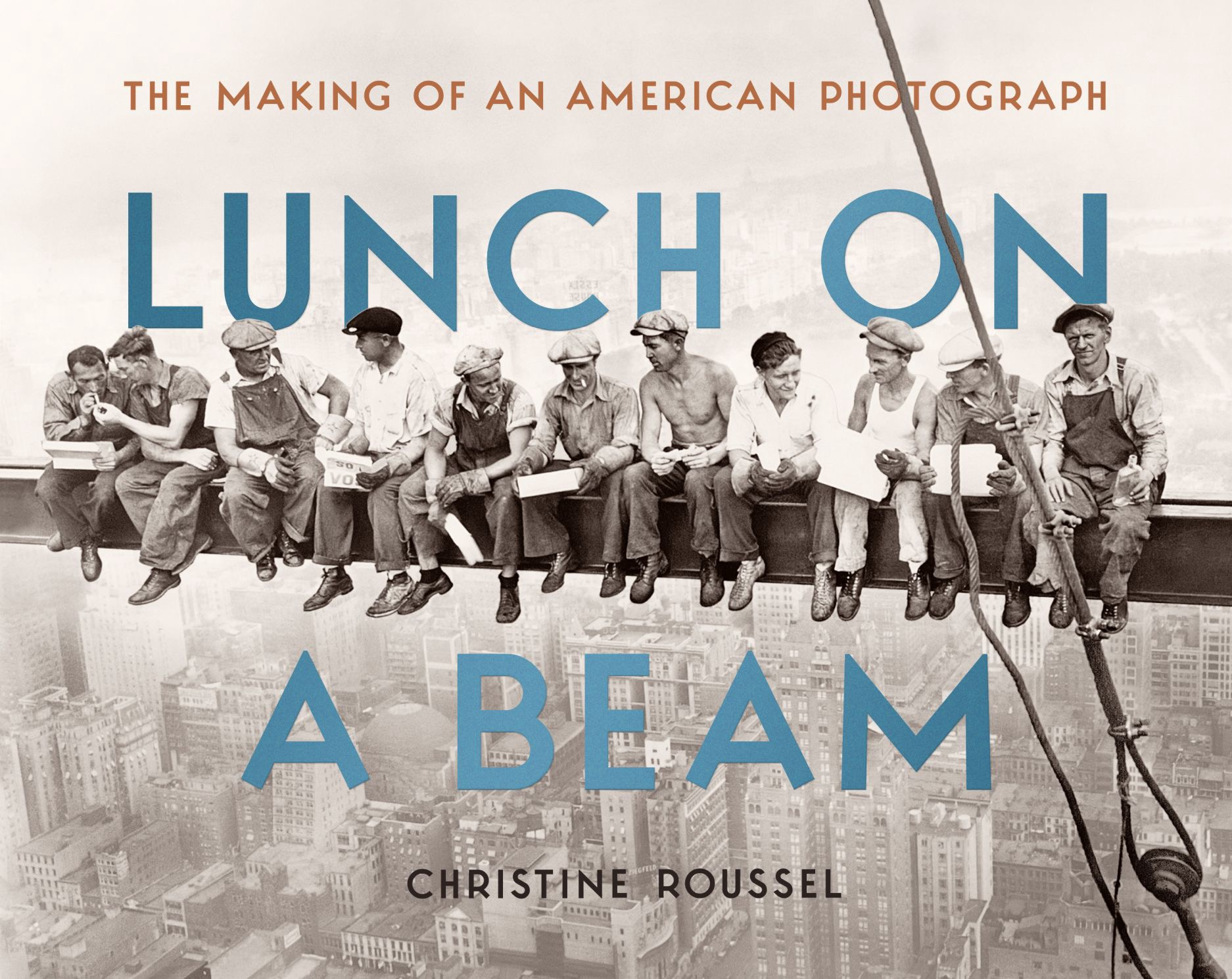
A picture may be worth 1000 words, but this picture, the centerpiece of Christine Roussel’s engaging Lunch on a Beam: The Making of an American Photograph, shows a beam that sits atop 60,000 tons of structural steel, hoisted, positioned, and riveted into place in by as many as 400 ironworkers at a time in 102 working days in 1932.
That’s not an optical illusion you see, unless you think more than 800 feet is just a hop, skip, and jump. It’s a long way down from the top of what popular culture now calls 30 Rock—the building that was first named the RCA Building, then the GE building, and finally (perhaps finally) the somewhat less majestic “Comcast Building.” For simplicity’s sake, let’s call it 30 Rock, not just because that’s what everyone else does, but also because its original values derived from John D. Rockefeller Jr.’s vision for a retail and cultural center in the middle of Manhattan.
Roussel is the Rockefeller Center’s archivist, a job which has afforded her access to voluminous documentary evidence. It has also given her legitimacy as she has hunted down leads to determine just exactly who were those guys so high in the air, and what intrepid photographer (or photographers) scaled the same iron they did to reach the top and get the view. That she consulted so many documents and spoke to so many people—everyone from family members with old photographs thinking they were a match, to members of the Mohawk community, apparently impervious to acrophobia, to union halls, and was still unable to gain certainty is both disappointing and oddly satisfying. These ironworkers were part of a larger brotherhood—men whose grit, strength, agility, and skill built 30 Rock as they built New York. Perhaps they are best seen not as individuals, but as a team, reliant on one another, focused on the same goals, sharing the same risks.
Telling their story is part of her mission, and she does it well. The second part is telling the story of how Rockefeller Center was conceived, how the parcel was assembled, how the design, building, and decor of 30 Rock itself was created and selected, and even how it was staffed. While I have some quibbles about the book’s organization, and, occasionally, Roussel’s choices of emphasis, her retelling of the efforts of men, management, and machines is worth the read.