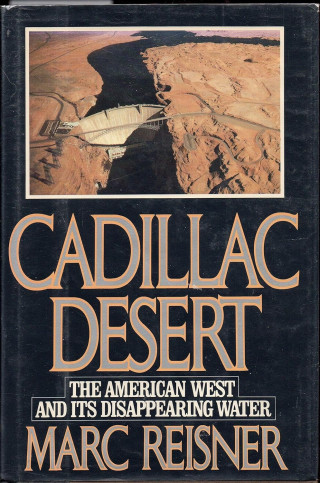
Cadillac Desert demonstrates, albeit implicitly, how a hypertrophic judiciary combines with America’s deadlocked legislature to make vast swaths of Western water policy dependent on 19th-century legal norms. Back in those days, whoever bought up the water first got to claim dibs, and if they didn’t use their whole allotment it was forfeited. With some exceptions, those norms hold to this day.
This opaque, unfair, byzantine system selects for politicians, judges, and bureaucrats who are good at backroom maneuvers. Rather than power flowing through channels voters can understand, it pools in the hands of obscure, well-placed individuals who are expert at working the mysterious levers of government. All our supposed checks and balances lead to a government where obscure bureaucrats and judges wield enormous authority, with little or no accountability.
ANOTHER OF REISNER’S VILLAINS IS FLOYD DOMINY, commissioner of the Bureau of Reclamation from 1959 to 1969. His behavior bears a striking resemblance to that of Robert Moses as described by Robert Caro in The Power Broker. Dominy was an ambitious, domineering man who became an expert at Machiavellian scheming, cultivated close relationships with powerful politicians like Hayden, and wielded the resulting power to get what he wanted.
As Reisner shows, the division of responsibility between the Corps and the Bureau combined with the 19th-century legal framework for water use to create an array of terrible water projects. The two agencies fought aggressive turf wars to hoard as many projects for themselves as possible, knowing that whoever got their projects built first would have legal priority. The Missouri River projects were so bad in part because the two agencies got in such a bitter catfight over priority that President Roosevelt threatened to turn them over to a new Tennessee Valley Authority–style agency, after which they hurriedly agreed to just build both plans at once.
But Reisner dismisses the possibility of a single, democratically accountable water agency implementing a clear national plan. Without the rivalry between the Bureau and the Corps, he suggests, things would have been even worse. Had they “really cooperated … there is no telling what they might have built,” he writes.
This anti-government attitude was deeply ingrained in the 20th-century environmental movement, where it remains to this day. The implicit assumption was that if the government wanted to build something, it would be an environmental disaster. That was often correct in the 20th century, but today, with climate change tearing up the country, swift government action to slash carbon emissions is vital, and an anti-government approach is not helping. A transmission line carrying power from a huge New Mexico wind farm to Phoenix broke ground in 2023 after 17 years of administrative delays, many stemming from environmentalist lawsuits.