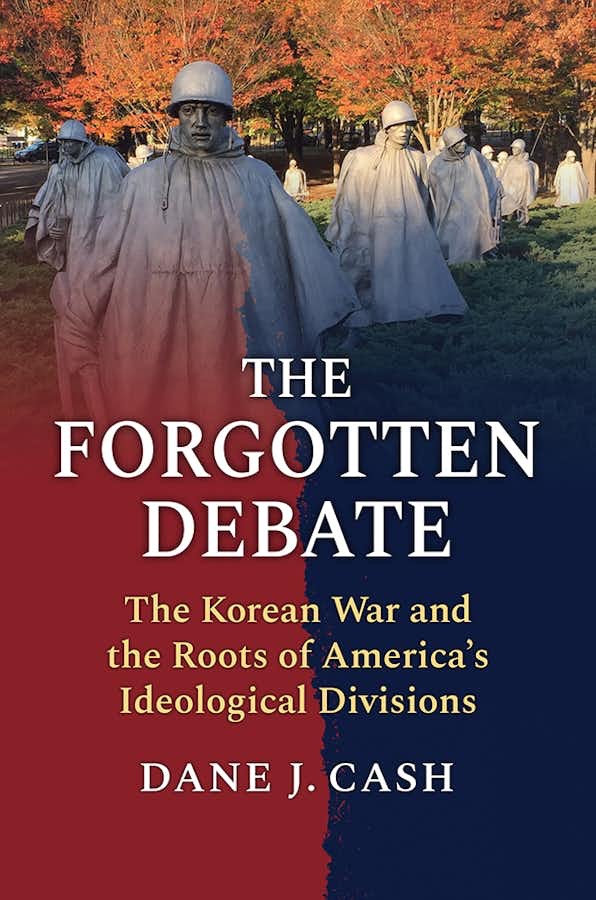
In his new book, The Forgotten Debate, Professor Dane J. Cash of Carroll College helpfully questions any such notion of a liberal Cold War consensus during the early 1950s. Cash does not claim to study ideological divisions among leading politicians of that time, nor does he investigate broader US public opinion. Instead, he zeros in on public intellectuals of the day, drawing from a few leading journals, and delineates three broad schools of thought: left-liberals, hawkish liberals, and conservatives. Cash concludes by arguing that these divisions foreshadowed later divisions over Vietnam and beyond. Specifically, he maintains that hawkish liberals left the Democratic Party after it turned in a dovish direction, leading to the rise of neoconservatism—an important influence on Republican Party foreign policy thinking well into the twenty-first century.
Cash finds an outspoken left-liberal worldview during the early 1950s, best represented by The Nation, ready to criticize Truman’s policy in Korea from a “progressive” perspective. Editor Freda Kirchwey harbored a soft spot for Chinese Communism and tended to oppose containment by military means. She seemed far more alarmed by Joseph McCarthy than by Mao Zedong. What support The Nation was willing to give Truman was typically of the hand-wringing variety, more worried about supposed American aggression than that of the Communist bloc.
The leading contemporary venue for hawkish liberals was the New Leader, published by the American Labor Conference on International Affairs. The journal supported Truman’s domestic welfare measures but castigated the policy of containment as overly timid. Authors such as David Dallin argued, based on personal experience as a one-time Menshevik, that Communist regimes were implacably hostile toward the United States. The Korean War was therefore an opportunity to liberate mainland China as well as North Korea from Soviet influence. Dallin supported not only General MacArthur’s march to the Yalu River in October 1950, but also the possibility of US airstrikes in Manchuria with the aim of anti-Communist rollback or liberation.
Meanwhile, conservative journals such as The Freeman and The American Mercury underwent a transformation of their foreign policy thinking. Up until 1949, Old Guard Midwestern Republicans like Senator Robert Taft (R-OH) tended to oppose US military interventions abroad. But the apparently relentless expansion of world Communism, including Mao Zedong’s victory in mainland China, convinced most on the Right that the time had come to push back. Staff at The Freeman and The American Mercury agreed. Initially skeptical of US military interventions overseas, both journals switched to a hawkish position on Korea during the opening months of the war. In fact, they went even further than the New Leader.