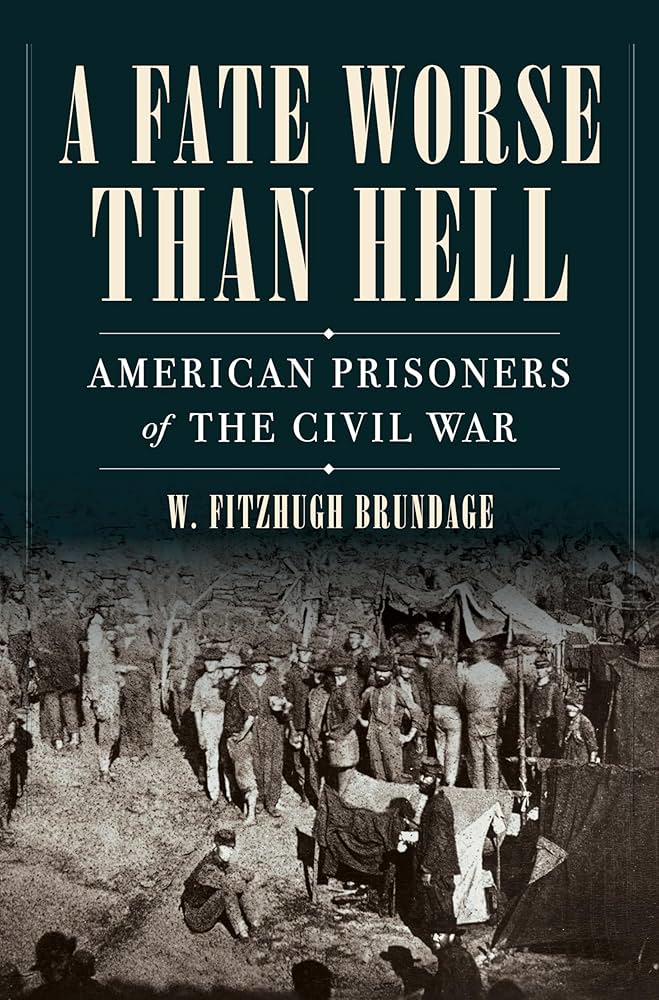
Brundage characterizes the creation of the camps as an “innovation,” describing them as “experiments in custodial imprisonment” that exceeded anyone’s prewar imagination. These were modern inventions made possible by the introduction of railroads to transport prisoners long distances from battlefields, and by the growth of administrative and organizational structures required to manage not just mass armies but hundreds of thousands of prisoners. Although they emerged out of war-born imperatives, the camps were, he insists, a choice made by northern and southern policy makers alike, motivated by assumptions and purposes for which Brundage argues they must bear responsibility.
Both sides believed that any sympathetic act toward the enemy would represent an insult to their own soldiers. The Union commissary general in charge of prison administration proclaimed that “it is not expected that anything more will be done to provide for the welfare of the rebel prisoners than is absolutely necessary,” and that work on a prison camp under renovation should “fall far short of perfection.” During spring and summer months, he mandated that any clothing distributions include neither underwear nor socks.
But whatever the moral and logistical shortcomings evident on both sides, Brundage draws a clear distinction between North and South. “By any reasonable measure,” he judges, “Confederate prisoners were better kept than their Union counterparts.” Southern officials, he concludes, “never fully accepted the obligation to provide for prisoners of war.” Union prisoners were regarded not as human beings but as “a security liability that imposed no ethical imperative.” The South housed its captives in ill-adapted existing spaces. Richmond’s Libby Prison was a converted tobacco factory; the Salisbury, North Carolina, prison had been a textile mill; camps in Montgomery and Tuscaloosa, Alabama, and Macon, Georgia, were former slave jails. At the notorious Andersonville camp, no structures were provided at all. Men were not even issued tents but scrounged to procure shirts, blankets, or other bits of cloth to drape over sticks of wood to create what they called “shebangs.” Those unable to find cloth or wood dug holes in the ground.
The Union, in contrast, erected barracks and designed purpose-built enclosures for this new experiment in large-scale imprisonment. Those overseeing Union prison camps acknowledged that providing food and shelter for captives was indeed a moral obligation, even if on numerous occasions they failed to deliver adequately on that commitment. Yet the 25 percent death rate at the North’s worst prison, in Elmira, New York, came close to that at Andersonville (29 percent); overall, the mortality rate was 16 percent for Union prisoners and 12 percent for Confederates. Cruelty and corruption recognized no regional boundaries, and officials on both sides seem to have come closer to despising than sympathizing with their suffering captives.