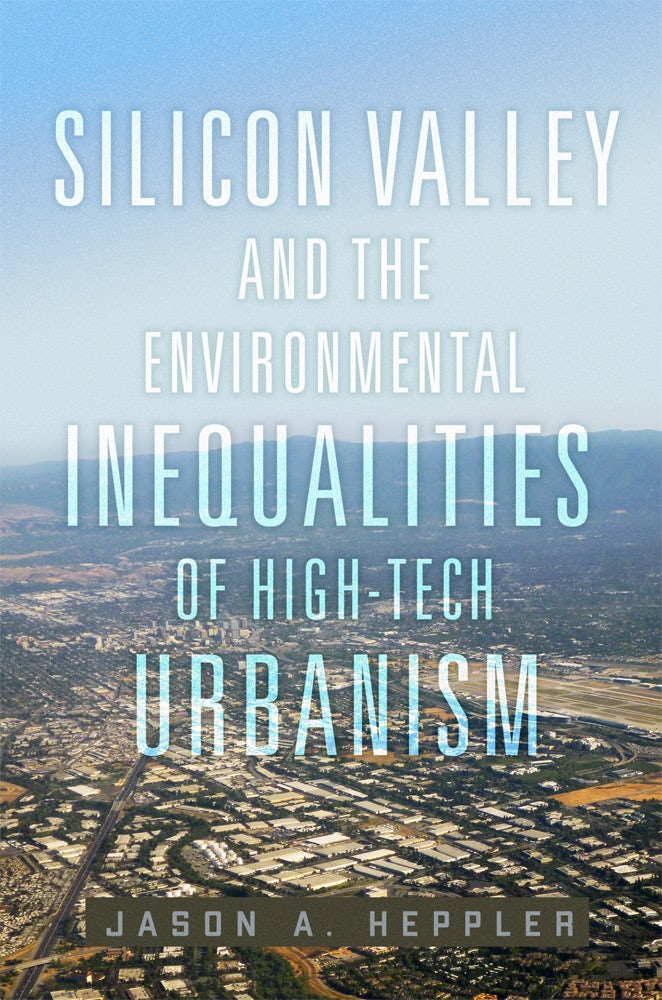
Heppler’s narrative runs roughly from 1945 through the 1980s. Short sections at the beginning examine the agricultural history of Santa Clara Valley, which was the region’s defining activity until the midcentury. Its terrain extended from the fringes of San Francisco southward to San Jose and out to the farming and bedroom communities of Gilroy and Hollister. Crops could be cultivated on an industrial scale thanks to the favorable climate and fertile soil. By the time the United States entered World War II, there were some 6,000 farms, with more than 130,000 acres under tillage. This changed at the end of the war when millions of cherry, apricot, and pear trees were demolished to make way for development. One Santa Clara County planning official observed that you could always tell when an orchard was about to be replaced by suburban development. Strawberries would go in, he said, because “[t]hat’s a quick, one-season crop while you wait for a buyer with the right price.”
Whereas conventional histories of Silicon Valley point to Stanford University’s research acumen as pivotal to the region’s transformations, historians of urbanism and political economy have pointed to other factors, focusing—quite rightly—on the essential role that defense-related largesse and favorable tax codes played in catalyzing transformation. Heppler adds yet another factor by way of real estate. Stanford University was the region’s largest landowner, controlling over 8,100 acres, which Leland and Jane Stanford had gifted to the school with the proviso that it could not be sold. That proviso was extraordinarily consequential. For several decades after the university’s founding in 1885, the land was used mostly just for ranching and recreation.
After 1945, Frederick Terman, the school’s ambitious provost, needed to mobilize substantial funds—enough funds, as he saw it, to catapult Stanford into the ranks of MIT, Berkeley, and Harvard. The university therefore launched a planning office in 1945, which, by the 1950s, had seized on the idea of renting university-controlled land for light industry and commercial development. A bonus: It would help create “a community in which work, home, recreation, and cultural life” would be “brought together with some degree of balance and integration.” Alf Brandin, a young Stanford alum hired in 1946 as the university’s business manager (in 1959, he was made vice president for business affairs), oversaw much of this activity. A high-end shopping center, for instance, brought hundreds of thousands of dollars into the university’s coffers.