PETER: You’re listening to a special Civil War anniversary edition of “BackStory” with the American Backstory hosts. We’ll be back in a minute. [music] This is “BackStory,” the show that takes a topic and considers it from the perspective of three different centuries. I’m your 18th century guy, Peter Onuf.
ED: I’m your 19th century guy, Ed Ayers.
BRIAN: And I’m the 20th century guy, Brian Balogh. Today on our show, we’re exploring the motivations of soldiers on both sides of the American Civil War. Most people agree that slavery was at the root of why the war started, but if most Southerners were not slaveholders, and most Northerners weren’t abolitionists, then why were so many thousands of people willing to put their lives on the line?
ED: That’s a question that’s really challenged historians for many years in large part because there’re so many answers that are at least partially right. Now, there’s a historian Adam Goodheart who’s the author of a new book called 1861: The Civil War Awakening. He’s also one of the main contributors to “Disunion”—a New York Times blog that chronicles the events of 150 years ago. And in his research for both projects, Goodheart had discovered that there was an enormous range of considerations that factored into people’s decisions in the lead-up to the war.
ADAM GOODHEART: I found a letter in a sort of a bundle of letters in an attic a few years ago on the Eastern Shore of Maryland, a bundle of letters from an Army officer from the spring of 1861 trying to decide which side he was going to go with and on the one hand, he was a slave-owner. He was from a slave owning family. He’s grown up in the Southern state of Maryland. On the other hand, he’d been an Army officer. He’d been under the Stars and Stripes since he was a 14-year-old cadet at West Point and he’s having a correspondence. He’s stationed out at a fort out in Indian territory in what’s now Oklahoma and he’s corresponding with his wife and his brother back East and some of the decision has to do with slavery. Some of it has to do with the Union and some of it has to do with which way Maryland is going to go but then he’s also talking about, well, what’s this going to mean for my own career. His wife writes something that really stuck with me. She said, “It is like a great game of chance.” And I thought, well, gosh, he’s trying to decide, well, if I join this Confederacy will I end up as one of the founding fathers of a new nation or will I end up as a traitor being tried for treason.
PETER: In the end, that officer decided to stand by the Union or at least by his career in that Union, and if his choice about which side to fight for seems like a tough one, then what about all the ordinary civilians in the North who had to decide whether to fight at all? Joining the Army would mean leaving their jobs and yet tens of thousands of them flocked to answer Lincoln’s call for men. So how do we explain that?
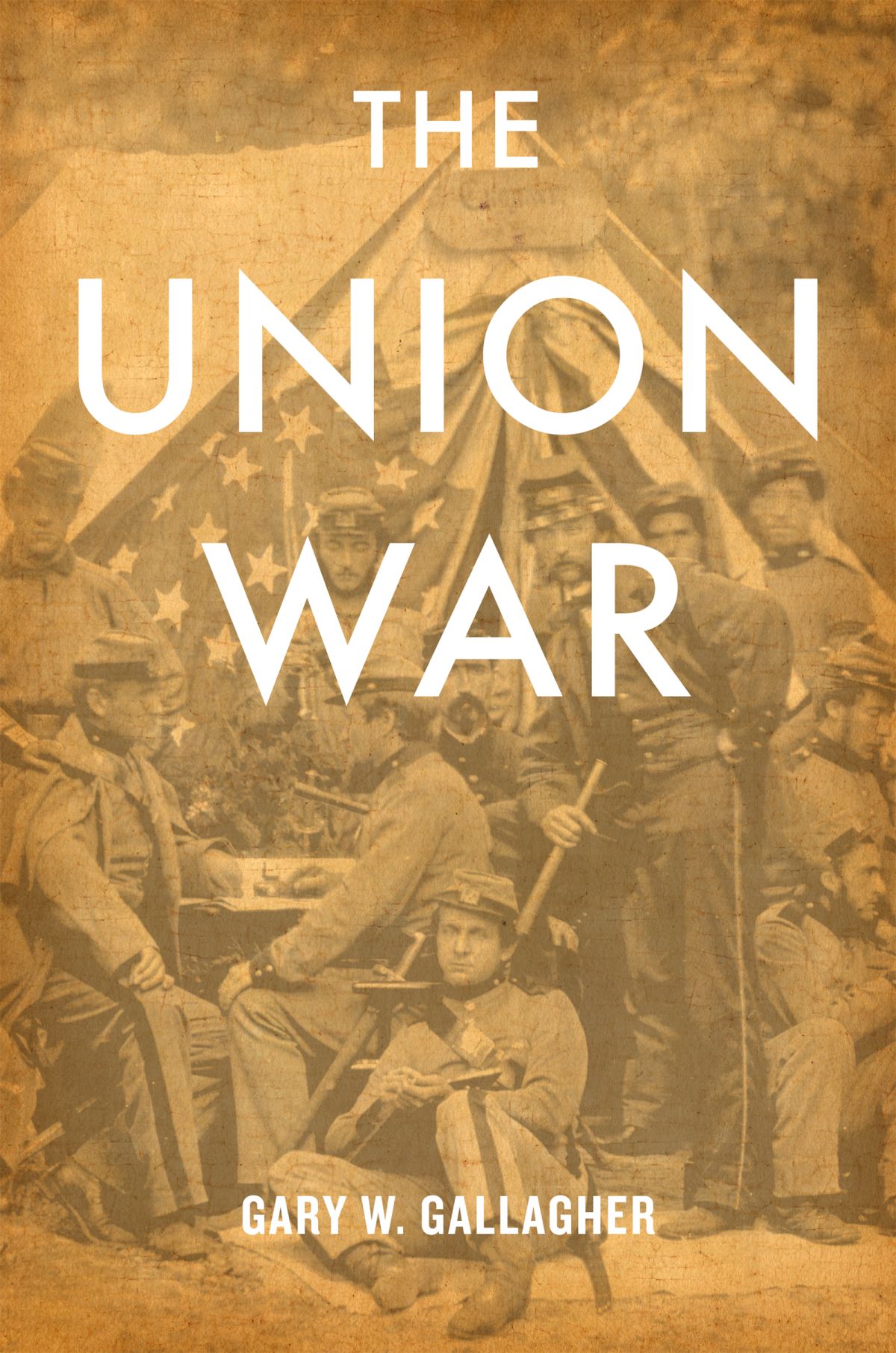
BRIAN: Well, fortunately, Peter, we don’t have to explain it. We brought in our colleague Gary Gallagher, University of Virginia historian who wrote a book on this very issue. It’s called The Union War and it argues that while the Southern states went to war to protect slavery, the vast majority of Northern men who volunteered to fight did not oppose slavery. Even after Lincoln issued the Emancipation Proclamation in 1863, Gallagher says that ending slavery was for most of them purely a military strategy. That’s why they went along with it. He says that if you asked these guys what really compelled them to take up arms, they would have answered that it was their deep commitment—hold your breath—to Union. Now, if you’re scratching your head on that one, you’re not alone. I was a little confused by it also.
[music]
BRIAN: You know, Gary, that I’m the 20th century guy on this show.
GARY GALLAGHER: I’ve heard that.
BRIAN: And I just can’t understand how all these men could fight and many of them die for something as abstract as Union. Can you explain to our listeners what Union meant to these men?
GARY GALLAGHER: I think what Union meant at the absolutely base for the mass of white Northerners was it meant a small “d” democratic republican system that gave a common person a voice in his own government—men are voting. Only men are voting. We know that—in his own government and it provided economic opportunity, not a guarantee for economic success, but much greater economic opportunity than any aristocratic or oligarchic society had and that was something that they treasured and they had imbibed Daniel Webster’s great rhetoric. It’s everywhere. It shows up in advertisements—Liberty and Union, Liberty and Union, and what they meant by liberty is not what we would normally think about. Liberty is often tied now to your attitude toward slavery. That is not how they would’ve deployed that word for the most part. Liberty for them meant freedom to enjoy these political rights and a chance to move ahead in an economic sense.
BRIAN: And I’m really struck by the comparative nature of your answer. We think today we live in a world of globalization—
GARY GALLAGHER: Right.
BRIAN: But you were saying that these people woke up thinking I may not have much money, I may not have much education right now, but I’m special because I can vote and I can have a say in my government and millions of people around the world don’t have a chance at that. Am I getting that right?
GARY GALLAGHER: That’s absolutely right and they not only thought it, they wrote it down and they wrote it down sometimes in language that makes it clear they had very little education. They’re literate but barely literate and they had a poster example of this in the presidency. Abraham Lincoln literally did what they believed this system allowed people to do, literally go from—
BRIAN: That’s the opportunity part.
GARY GALLAGHER: That’s the opportunity. That’s the opportunity and they compared themselves again and again and again to Europe and they were well aware of the failed revolutions of the late 1840s in Europe. They believed that if the Union failed, if after an election, a legal election, if the party that lost that election could simply destroy the nation because they weren’t happy with the result, then the aristocratic oligarchic monarchical Europeans could look and say we told you a democratic republic could not work.
BRIAN: So it’s almost as though they viewed those slaveholding aristocratic-leaning Confederates as the kind of shock troops of the aristocratic model around the world that was just waiting for America.
GARY GALLAGHER: They wouldn’t have said aristocratic-leaning. They would’ve said the words they used, the word “oligarch” came up a stunning number of times to me. I was really struck in doing the research for this book how often the word “oligarchy” was applied to the slaveholding class of the South. They called them aristocrats. They called them oligarchs. They said they were absolutely inimical to what the United States was about.
BRIAN: So, in a way, you’re saying they were fighting against those slaveholders.
GARY GALLAGHER: They were, yes.
BRIAN: They just weren’t fighting against slavery. They weren’t terribly upset by slavery per se, except that to have slavery, you needed slaveholders which defied the very concept of a democratic republic.
GARY GALLAGHER: That’s absolutely right and they sought to punish the slaveholding class which had caused the whole problem in the first place, they believed, and there’s no better way to punish the slaveholding class than to take their slaves away from them because they’re property and slaves was the basis of their power and so get rid of them.
BRIAN: Yeah. Well, Gary, let’s get down to brass tacks. What public opinion polls did you consult for your study?
GARY GALLAGHER: I used the three major ones that were available in the mid-19th century. [laughter] There’re no public opinion polls.
Peter: Oh, God.
GARY GALLAGHER: What I did was try to put different kinds of evidence in conversation with one another. For example, I read— There were two major illustrated weeklies at the time, equivalent of Life and Look really, Harper’s Weekly and Frank Leslie’s Illustrated Newspaper. I read every word of every issue of those for the whole war to see how this sentiment—
BRIAN: That’s why I haven’t seen you for years.
GARY GALLAGHER: Yes, I’ve been— Yeah, I don’t have a tan anymore. I also looked at soldiers’ letters. I looked at letters from people behind the lines. I mean, I used different kinds of evidence, fully aware of the fact that this is not a science. There’s nothing scientific about this and anybody who pretends they can get a scientific sample of letters from the Civil War is either deeply ignorant or dissembling because it just can’t be done. It can’t be done.
BRIAN: Well, this has been so informative. We have a guy on the show who claims to know about the 19th century, Ed something. Ed Ayers, that’s right.
GARY GALLAGHER: I’ve been one of Ed’s admirers since I was a little boy. I mean, I grew up sort of idolizing Ed. [laughter]
BRIAN: Now, he is getting up there in years. Now that you’ve explained to us why the North fought, I felt we could bring Ed in. He just happens to be standing outside looking just so anxious to get into this conversation. Ed, come on it.
ED: [sound effect] Hey, everybody. It’s good to see you. I didn’t know how long you’d leave me with my face pressed up against the glass there.
BRIAN: I know. I know you’ve been listening in and I’d just be curious to get your thoughts about what Gary’s had to say, especially about Union and about why men in the North fought for Union.
ED: Well, you know, it takes a little bit of the drama out of it to say that I think he’s exactly right about the motivations of people at the beginning. I do think, though, if you read our textbooks, there is a general sense embodied in Abraham Lincoln of a sense of a moral growth over the course of the war and that is Northern soldiers come into contact with enslaved people as African Americans fight 200,000 strong in the United States Colored Troops, as people begin to wonder if this amount of bloodshed must not have a larger redeeming purpose as Abraham Lincoln says, some kind of providential reason to obliterate slavery. People often think that the white North develops a greater understanding of slavery and its injustice over the course of the war. Would you agree with that or not?
GARY GALLAGHER: Not in the way you put it. I think the big problem we have is not accepting the fact that for most of the white North Union was a completely sufficient reason to fight the kind of war they fought. Union meant so much to them. I mean, a number of historians have said Union wasn’t worth the loss of a single life. Well, that would’ve been stunningly wrongheaded to people who lived in the loyal states. I don’t think there was a great moral shift. I do believe that some Union soldiers surely changed their views about African Americans when they saw slavery up close, but many others had earlier notions about black people actually confirmed and their letters make that clear. The prejudices came out more on the wrong side of things from our point of view. I think there’s quite a variety of reactions to seeing slavery and seeing African Americans up close.
In terms of Lincoln, Lincoln’s second inaugural, of course, is the place that we go to see this change in this almost spiritual take on what the war was about, but Abraham Lincoln’s message to Congress in December 1864 which is after the elections—there’s no reason for him to pitch this to the loyal population if he didn’t think that most of them still focused on Union—he said in a great war such as this, you need to have one thing (I’m paraphrasing him) which everybody believes and he said, in our war, it’s Union. He said killing slavery is one of the means to achieve that great end that we all agree on. That’s December of 1864, so I just think that Union is most important in 1861, ’63 and ’65.
ED: So, Gary, since we know that we’re writing history for today to help us understand what the Civil War means for us, you are taking advantage of the fact that we’ve now recovered the African American component of the war and you don’t try to displace any of that, but you’re trying to restore an understanding that in alliance with that was a dedication to Union. Does that speak to our current time in some way that we need, you think?
GARY GALLAGHER: Well, I guess my principle goal isn’t to speak to our current time. I think it’s important in our current time to understand the complexity of our past and I think that if we’re going to come to terms with the Civil War, we have to understand that it isn’t exactly what we wish it had been, but one of the points I make is that it’s sort of miraculous that a mass of white Northerners who were as racist as they were would be transformed by this giant military event into a population that believed slavery must be killed and I think that is a radical transformation within a mid-19th century context and I think it shows the capacity for growth and change in the direction we would say is the right direction even if it’s not for exactly the reasons that we would prefer that it had taken place. I think that’s important to know.