The violence that spread across Harlem on the night of March 19, 1935 was the first large-scale racial disorder in the United States in more than a decade and the first occurrence in the nation’s leading Black neighborhood. However, as many observers pointed out, the events were “not a race riot” of the kind that had marked the decades after the Civil War. Racial violence took a new form in 1935.
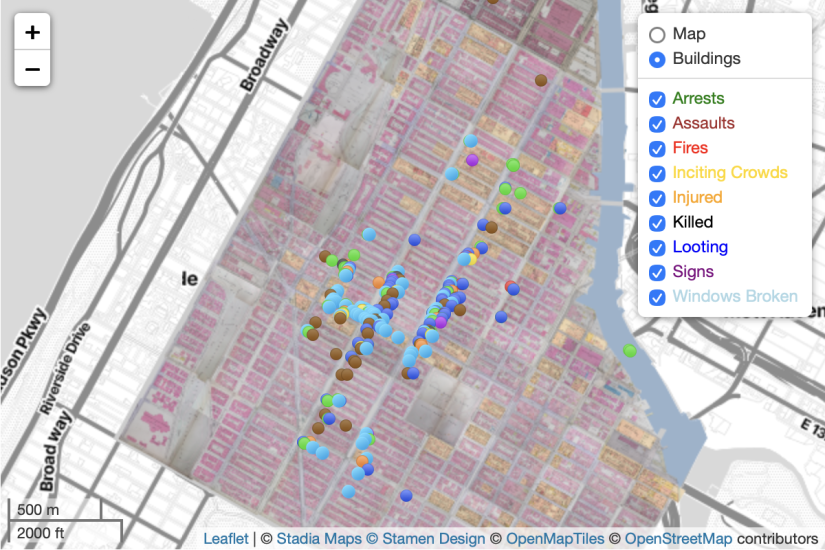
Through a granular analysis of those events and the mapping of their locations, Harlem in Disorder reveals that Harlem’s residents participated in a complex new mix of violence that was a multifaceted challenge to white economic and political power. Tracing the legal and government investigations that followed, this project highlights how that violence came to be distorted, diminished, and marginalized by the concern of white authorities to maintain the racial order, and by the unwillingness of Harlem's Black leaders and their white allies to embrace fully such direct forms of protest.
Focused on capturing rather than simplifying the complexity of the new form of racial violence, Harlem in Disorder is a multi-layered, hyperlinked narrative that connects different scales of analysis: individual events, aggregated patterns, and a chronological narrative. Its structure foregrounds individual events to counter how data can dehumanize the past, and to make transparent the interpretations involved in the creation of data from uncertain and ambiguous sources.
Introduction
The outbreak of disorder in Harlem on the evening of March 19, 1935 immediately attracted national attention as the first large-scale racial violence in the United States in more than a decade, and as the first occurrence in the nation’s leading Black neighborhood. Historians subsequently seized on it as an outburst that illuminated the end of Harlem’s status as a center of cultural production and empowerment, akin to the interpretation of the racial disorders of the second half of the twentieth century as “an explosive, unproductive response to decades of northern racism.” That focus on underlying grievances, not the events of a disorder, has been widely adopted as an approach in the study of collective racial violence in the United States. Since the 1960s, scholars have recognized that the outbreak in Harlem also marked a beginning: the first instance of a new form of racial violence characterized by Black residents attacking property rather than white men and women attacking Black residents, who resisted that violence, as was characteristic of outbreaks earlier in the twentieth century. However, that interpretation was not based on any detailed analysis of what happened on March 19 and the early hours of March 20. While historians generally acknowledge the multifaceted nature of racial violence, in keeping with the general approach of historical argument, their interpretations have involved selecting one thread to emphasize. Such methods necessarily simplify the character of racial violence and obscure the balance and relationship between different forms of violence.
This study reverses that approach and analyses the details of what happened and where those events occurred to understand the complex character of the disorder in Harlem in 1935 and how it fits in the broader history of racial violence in the United States. In doing so, it responds to Amanda Seligman’s call in her award-winning article on disorders in 1960s Chicago to “look inside a riot and examine both the actions of participants and the responses of their neighbors.” “Cracked open,” disorders can reveal a broad range of actors pursuing a variety of goals rather than a community unanimous in sentiment, “periods of action punctuated by rest and quiet” in rhythms that were “irregular and staccato” rather than continuous activity.