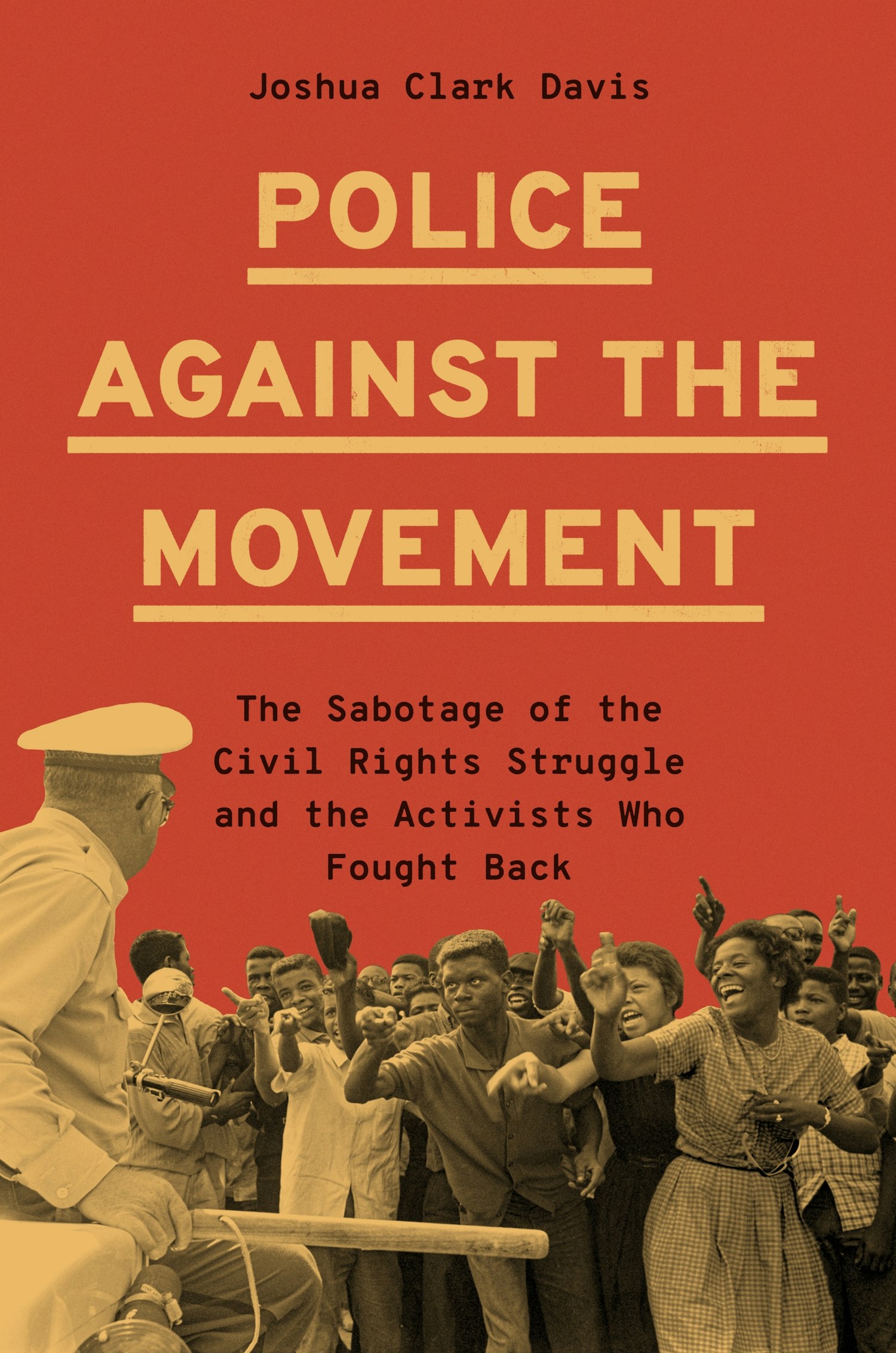
Joshua Clark Davis’s Police Against the Movement: The Sabotage of the Civil Rights Struggle and the Activists Who Fought Back excavates a more nuanced story. Instead of focusing on the most visible and well-known crackdowns, his account traces the police repression of Black Americans in its more insidious, day-to-day form, showing how civil rights activists identified that repression—and how they responded.
At the center of his narrative are the Student Nonviolent Coordinating Committee, or SNCC, and the Congress of Racial Equality, or CORE, the two more radical movement mainstays. By 1963, CORE had adapted its civil disobedience playbook, honed during the fight against segregation and disenfranchisement in the South, to demand an end to police violence across the North and West. Even before the Black Panther Party was founded in October 1966, both groups helped run community patrols to guard against white mob violence and monitor police abuses. The violence that SNCC’s and CORE’s organizers encountered in Birmingham and beyond led them to understand law enforcement not just as one brick in the wall of state-sponsored racist oppression but as something more like the keystone. Those dogs and hoses were a particularly blunt manifestation of official power, but not its only manifestation. Equally important, Davis shows how law enforcement across the country systematically surveilled, harassed, and repressed the movement—with local detectives on the front lines. The FBI’s infamous COINTELPRO operation targeting Black and antiwar radicals, he argues, can be better understood as “federalizing efforts that local police departments had already undertaken to disrupt the civil rights movement.”
For Davis, the movement’s constitutive battle is not Birmingham but Albany, Georgia, or Danville, Virginia. Albany’s police chief, Laurie Pritchett, had read up on civil disobedience. When the desegregation campaign came to his city in 1962, he realized the freedom riders were foregoing bail as a tactic, and so he conspired to pay King’s bond, releasing him from jail and taking the wind out of the movement’s sails. His goal was to “out-nonviolent” the protesters, Pritchett told interviewers later. His canny approach won him national praise: The New York Times depicted him as an “outstanding example of the new breed of Southern policeman.”
In the summer of 1963, after initially using the same playbook as in Birmingham, police in Danville switched course and began to fight back—“not with clubs and fire hoses but with mass arrests, felony indictments, and unrelenting surveillance,” Davis writes. They transferred detained activists to more conservative rural jurisdictions and constantly monitored local organizing; some town residents active in the struggle were kicked out of public housing or lost unemployment benefits. “Mass brutality was abandoned…. Less dramatic and more corrosive tactics were adopted,” the movement lawyer Len Holt recalled in his book An Act of Conscience.