Freelance Freak Show
The Left sometimes conjures the following sketch of how American politics arrived at the present reactionary moment: the Democrats tacked center, the GOP saw an opportunity to stretch rightward, and the Overton Window shifted. This tidy account assumes the band of acceptable opinion has a fixed width — so if one side retreats, the other can advance the same distance. That is, if one side stops insisting that workers need unions (which Democrats did), the other will opportunistically start trying to prohibit them from joining unions altogether (which Republicans have).
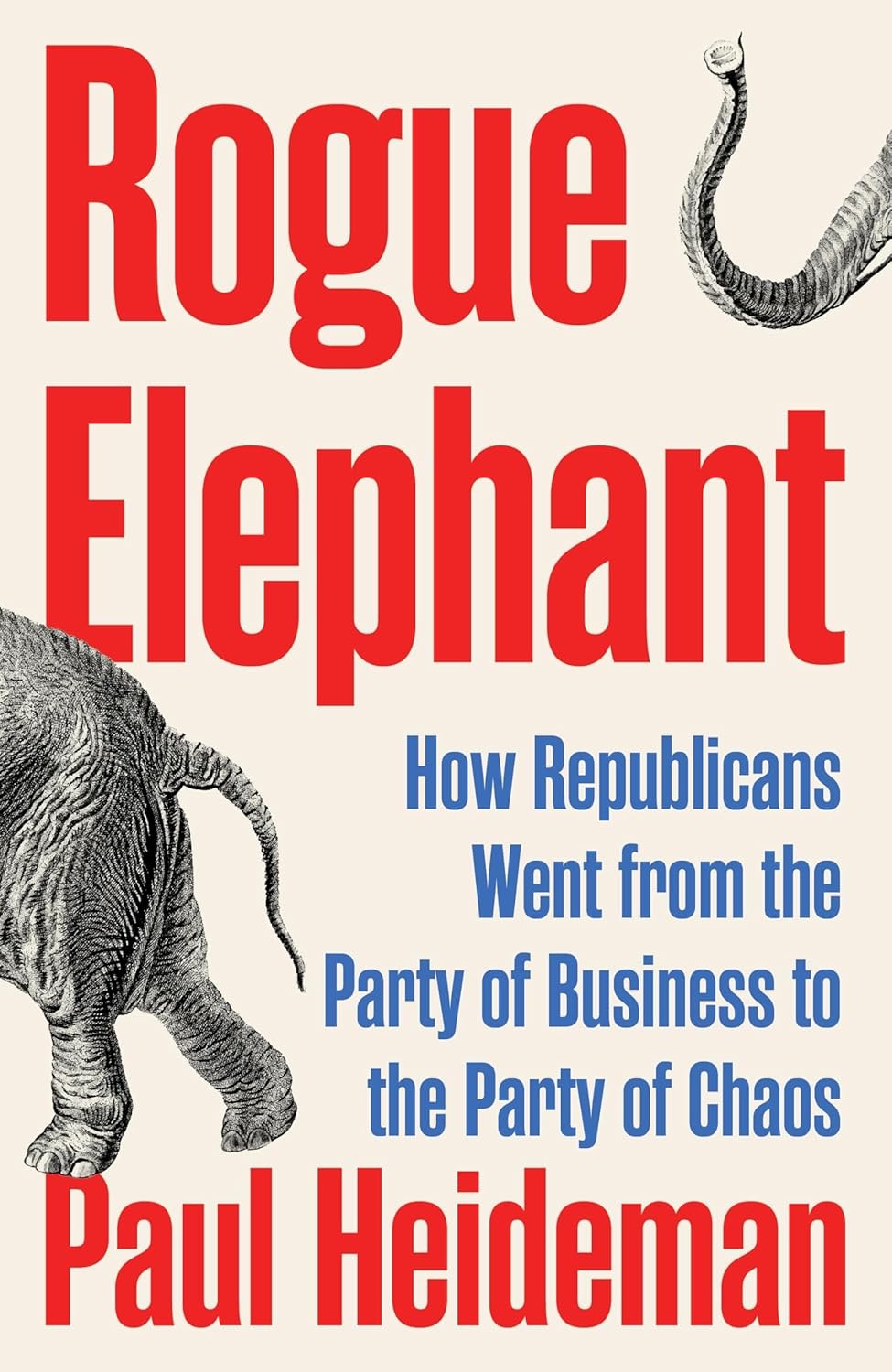
In Rogue Elephant, Heideman proposes a more dynamic and convincing account of rightward drift. Instead of two parties gliding rightward in unison, he emphasizes how parties in general have lost programmatic coherence, allowing political entrepreneurs to rush in and fill the vacuum. At the same time, deregulation of campaign finance means that these insurgents often bring with them independent funds, especially on the Right, where business interests have the most to directly gain.
Gone are the days of high-minded business consortia conditioning the Republican Party to ensure political stability on their behalf. We’ve entered the era of the political upstart, where self-selected aspirants raise money from individual capitalists or niche sectoral associations on the promise to act in their interests, with little regard for the future. Ideological incoherence gives these political entrepreneurs an advantage: flexibility to side with a given benefactor at will, guaranteed to find justification in a grab bag of muddled positions.
Since the ascent of Newt Gingrich in particular, Heideman argues, a cycle has been on endless repeat. “Insurgents in the party, able to draw on funds from sectors of business looking to push politics to the right, challenge the party leadership,” he explains. “Eventually, these insurgents manage to take leadership and succeed in their push. Then, a new crop of insurgents springs up, and the cycle begins again.”
The compound effect is intensifying intra-party conflict and an unmitigated, accelerating rightward drift. A further result of repeated coups against party leadership has been to minimize the significance of party leadership in general. No one can trust that a given leadership clique will be on top for long.
Before Trump, these dynamics were exemplified on the one hand by the Tea Party, stoking destabilizing factional conflict with a right-populist gloss and a hard-line attitude, and on the other hand by the Koch Brothers, representing the victory of boutique, hyper-ideological billionaire patronage. In 2010, the Citizens United Supreme Court decision turbocharged this trend, opening campaign finance to individual wealthy donors in unprecedented ways that further decreased dependence on and undermined the role of political leaders in the party.