The American presidency was forged in uncertainty. While George Washington served as the first president, his administration was full of unpredictability and surrounded by important questions. How will the president govern? What powers does he have? What powers does he not have? What is the relationship to Congress? These questions dominated the Washington presidency. But arguably, the second president had the harder task. George Washington was always the vision for the presidential role. At the Constitutional Convention, Washington’s own copy of the Constitution contains heavy annotation under Article Two, evidence that even he was preparing to give meaning to an office no one yet fully understood. When Washington announced his retirement in 1796 citing exhaustion and a longing for Mount Vernon, the nation confronted an even more unsettling question: How would the United States survive without him? Not if, but how? What would happen if the country could not survive without a leader whose authority extended far beyond written law? John Adams, the second President of the United States, was no George Washington.
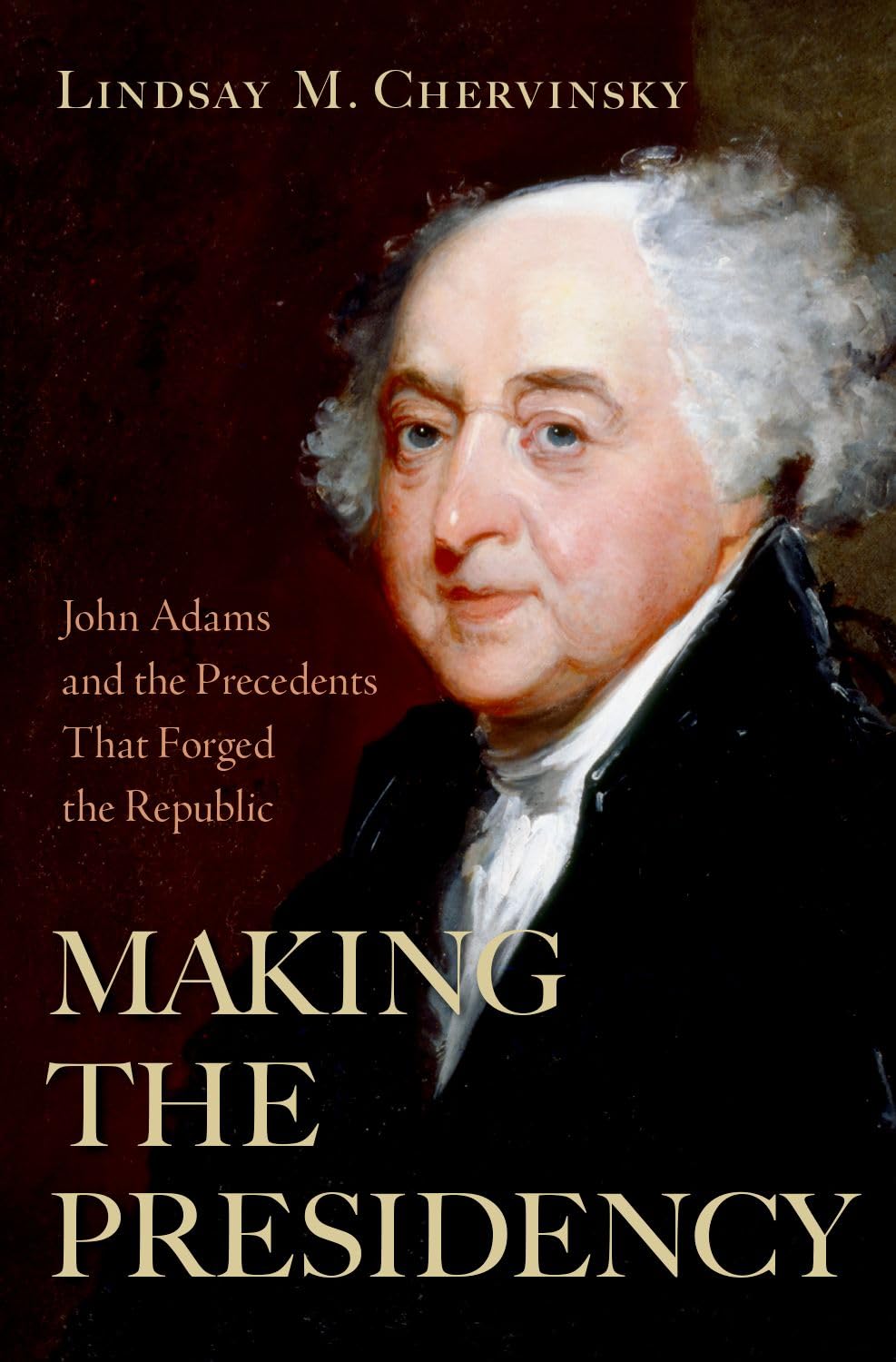
These questions are at the core of Chervinsky’s new monograph Making the Presidency: John Adams and the Precedents That Forged the Republic, where she details how Adams refined the still fragile template left behind by Washington. She writes that Adams “was tasked with navigating the presidency without that unique prestige” (2). This claim is not only descriptive but interpretive. It suggests that Adams’s choices were effectively arguments about the nature of executive power. Chervinsky argues that the difference between Washington and Adams is what makes the presidency so revealing. The navigation of the republic after Washington is the central focus of her book, and she is persuasive when she shows that Adams faced not only the responsibilities of the office, but also the responsibility of defining what the office was. Chervinsky treats Adams not simply as a statesman, but as a political thinker whose writings show how he reasoned through constitutional uncertainty. It is not a hagiographic portrait but rather examines how Adams’s own ideals shaped his decisions, sometimes constructively and sometimes problematically. This makes her work different from biographies that focus on Adams as a personality, such as David McCullough’s Pulitzer Prize-winning John Adams (2001) or Joseph Ellis’s Passionate Sage (1993). Instead, she follows the development of Adams’s political thought during a moment when the office itself was still under construction.