When the nascent Republican Party gathered for its second national convention in Chicago in May 1860, a relatively unknown Illinois lawyer surprised nearly everyone in securing the presidential nomination — or so the story goes. Having served only one term in Congress and given a series of notable speeches in a failed Senate campaign against Democrat Stephen A. Douglas in 1858, Abraham Lincoln was supposedly the Republicans’ compromise candidate — chosen because he was no radical on the question of abolition yet firmly committed to preventing the extension of slavery into the western territories.
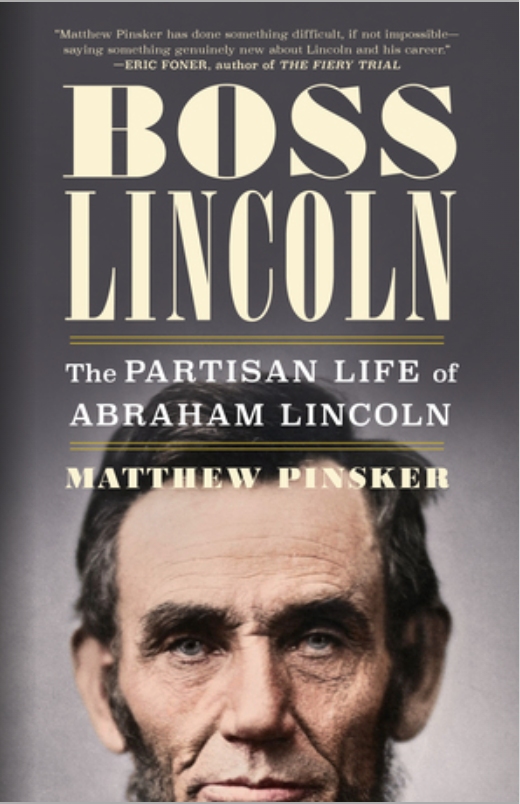
But as historian Matthew Pinsker reveals, Lincoln was not the unfamiliar, inexperienced politician that history and myth have suggested. By the time he secured the Republican nomination at Chicago, Lincoln had established himself as a master of party politics, or more precisely, a master of party organization. What Pinsker offers is not simply another biography of Lincoln. It is the story of the rise and fall of American political parties in the mid-19th century through the lens of one of the greatest party builders of the era.
Pinsker is particularly convincing in explaining Lincoln’s evolving partisanship. Timing is an important factor. Lincoln came of age in the 1830s just as political parties began to coalesce. As a Whig, he won several terms in the Illinois House before his election to Congress in 1846, serving only one term — he had announced he would not seek reelection before he ever took his seat. Contrary to Lincoln’s own mythmaking, he did not retire from politics in the early 1850s but continued to exercise political influence as a lawyer and lobbyist for large railroad corporations, Pinsker notes. By 1853, seven years before the presidential election and five years before the Lincoln-Douglas debates, the town of Lincoln, Illinois, was christened in his honor. Lincoln had emerged as the most prominent Whig in the state.
As sectional tensions escalated in the wake of the Kansas-Nebraska Act of 1854, Lincoln urged fusion between the dying Whig party and the growing antislavery movement. He turned his gaze toward a Senate seat and launched a letter-writing campaign on his own behalf, Pinsker says. The aspiring senator began his solicitations as a Whig but soon shifted away from the state’s conservative center. Ever the party operative, he compiled notebooks of state representatives and senators, detailing their partisan affiliations and employing a range of party labels. He noted that many had joined what he called the “Republican organization.”