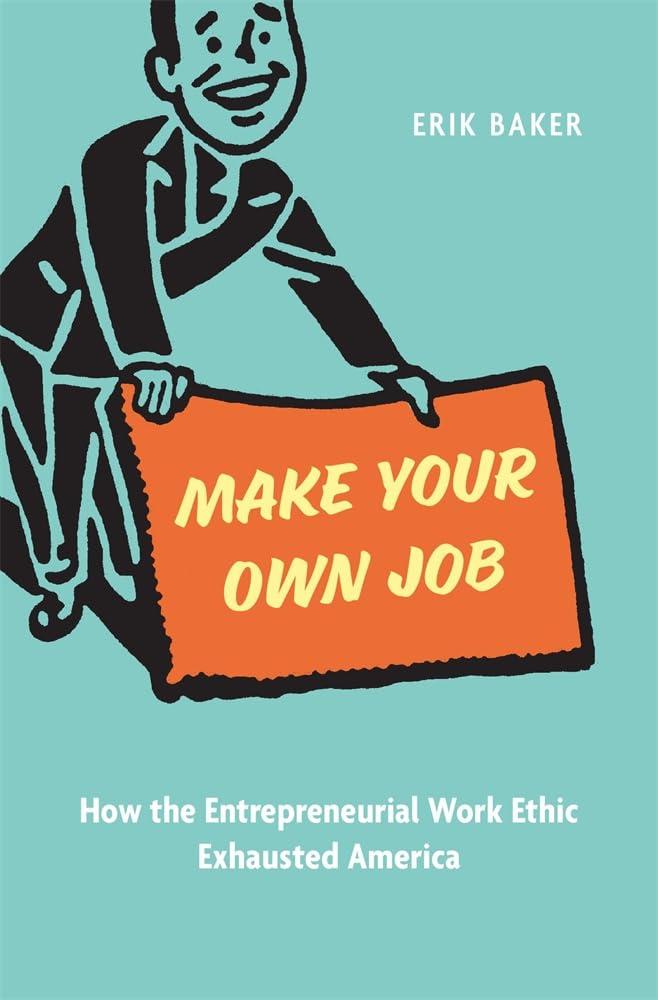
The entrepreneurial work ethic appears to be a top-down propaganda project pushed upon workers by capitalists. But two qualifications need to be made. First, the propagandists tended to believe their own propaganda (which is often the case, as intellectual historians know well). Second, the entrepreneurial work ethic seemed genuinely promising to some workers, especially women and racial minorities, or those likelier to be locked out of the industrial jobs. For a black man struggling to obtain a high-wage factory job, the idea that he might create his own opportunities was enticing by default. This historical tendency was personified by the black nationalist Marcus Garvey, who innovated his own shipping and passenger company, the Black Star Line, to avoid white capitalism and liberate black people. That victims of hiring discrimination were sometimes entrepreneurial enthusiasts led to some unusual political alliances. Harlem spiritual leader Father Divine, who preached positive thinking to black New Yorkers, also supported the Communist Party (CPUSA) presidential ticket in 1932, and not only because the CPUSA vice-presidential candidate James Ford, a black man, was on the ticket. “For ordinary black Americans who faced no compulsion to ideological purity,” Baker writes, “it was possible to accept the entrepreneurial work ethic as a program for individual success in the short term while still looking to revolutionary socialism to bring collective liberation in the long term.” Baker’s book acts as a relentless historical critique of the entrepreneurial work ethic. But he is sympathetic to those who embraced the ethic as a potential way around discrimination, from black nationalists in the early twentieth century to Girl Bosses in the early twenty-first.
The entrepreneurial work ethic gained more momentum during the early Cold War. A host of positive thinkers, including Dale Carnegie, Norman Vincent Peale, Henry Luce, and Peter Drucker, personified a dynamic brand of capitalism they believed was best positioned to win the battle against the faceless totalitarians of Soviet communism. More than a Cold War project, the entrepreneurial work ethic also had a domestic purpose. Communists were not the only enemies of individualism. Closer to home, two personalities stalked the American political imagination: people with what David Riesman called “other-directed personalities” who conformed to an increasingly mass society; and people with what Theodore Adorno termed “authoritarian personalities” who obeyed reactionary traditions. By threatening individualism these homegrown bogeymen, much like foreign communists, threatened American democracy. In contrast, the entrepreneurial work ethic, plucky individualism’s platonic ideal, doubled as a democratic way of life, or simply, the American way. According to management theorist Peter Drucker, if the United States was going to set a democratic example for the world, leaders in all sectors of society, from corporations to government to universities, had to think like entrepreneurs.