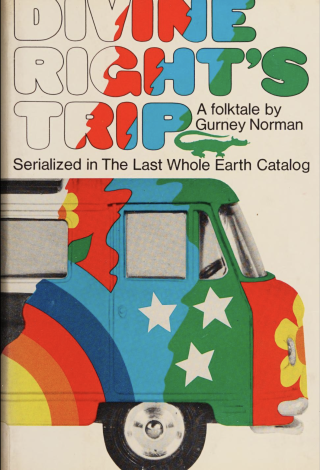
No single explanation can capture a movement as sprawling as the communitarian surge of the late Sixties, but a few broad motives stand out: opposition to the Vietnam War, a wish to escape a technocratic society, general mistrust of government, and the promise of autonomy through new information systems. But even as the communal experiment began to lose momentum, these impulses persisted, leaving editors of the Whole Earth Catalog to consider where the energy might go next. Stewart Brand increasingly looked to the emerging tech culture of Menlo Park, where new media and information tools seemed to promise easier connections across distance; the Catalog’s growing emphasis on books, data and systems theory already reflected this shift.
As Brand would write in the so-called Last Whole Earth Catalog: “We encourage others to initiate similar services, to fill the vacuum in the economy we stumbled into and are stepping out of.” Those who heeded the call, as the following decades would prove, were in the tech world, where entrepreneurs—including Steve Jobs, the founder of Stripe and some early Facebook employees—read it as an early map of digital possibilities. Computer scientist Alan Kay later described the Catalog a print prototype of the internet, and Divine Right’s Trip as an example of its brilliant user interface: a narrative thread that exposed readers to new information. But Norman’s novel traced out a route that turned away from Brand’s cybernetic frontiers.
As Norman later recalled, Brand visited him one afternoon in the backyard of his Menlo Park home. After two years of publication, Brand had decided to “kill” the Whole Earth Catalog and was looking for an idea for its final issue. Norman floated an idea: the Catalog ought to include a novel. Though at this point he’d mostly written journalism, he had left journalism in the first place in order to focus more on his fiction, and had drafted some still-unpublished stories during a summer as a fire lookout in the Cascade Mountains. Brand accepted, and they settled on a plan: the narrative would appear in tiny segments scattered throughout its pages, drawing on whatever products were listed in the same spread: if a Coleman stove appeared in an ad, the protagonist might use one for cooking. For this final issue, Norman accepted a $300 monthly stipend and holed up in his writing studio above a former fish-and-chips shop in downtown Palo Alto.