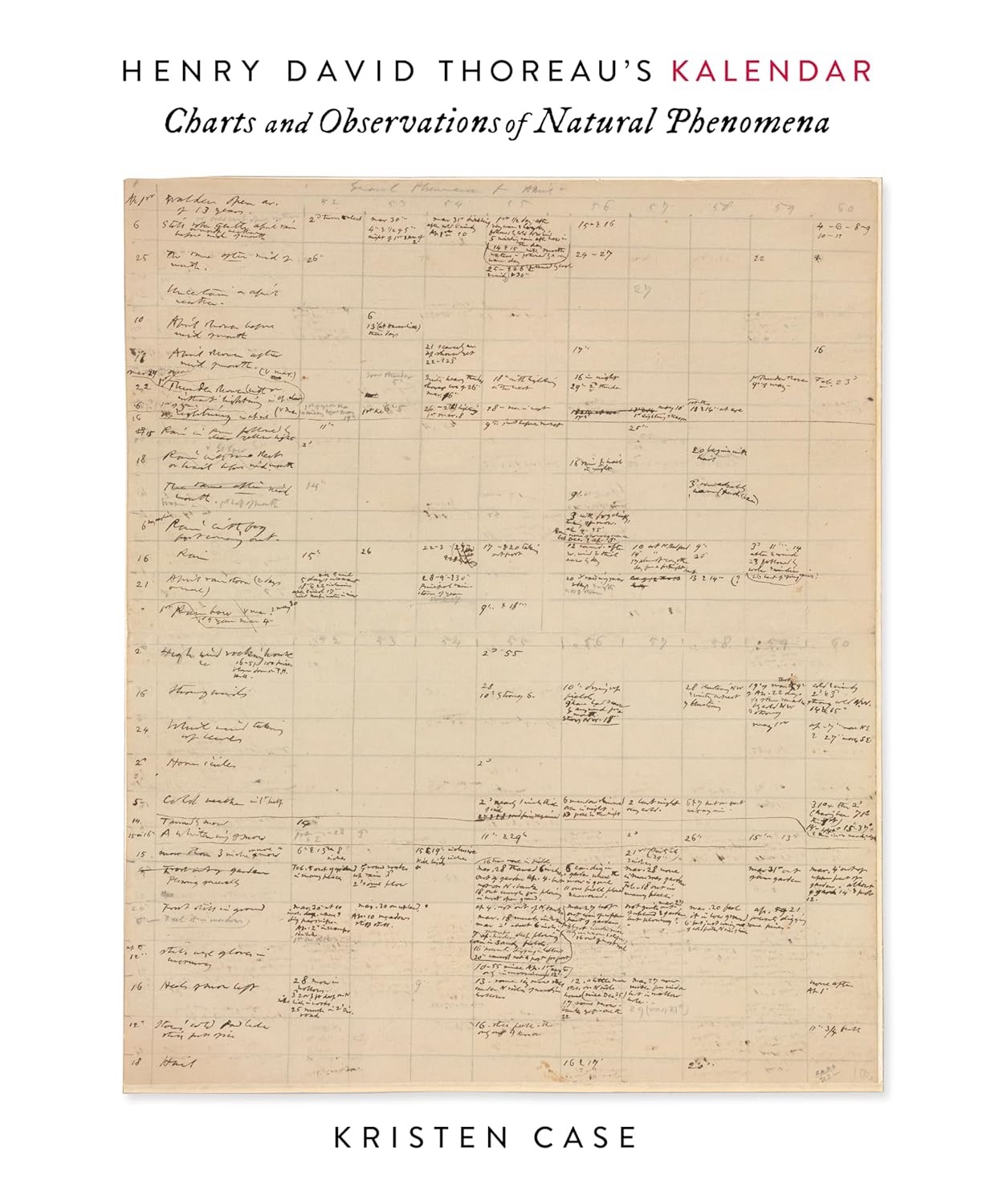
In the spring of 1860, at the height of his intellectual powers and the peak of his political engagement, Henry David Thoreau created something new. Part blueprint for a grand new work, part scientific chart, part picture of temporal experience, this something—which, following a suggestive Journal entry from October 1859 has come to be called his Kalendar—was more a tool than a text.
Comprised of six multipage charts of general phenomena, the Kalendar was an instrument for recording and perceiving not just annual, weather-related phenomena themselves, but also the hidden relations between them—between the skies of one June and the skies of past and future Junes—relations we often feel but can’t quite hold, stuck as we usually are in our own brief moment of linear time.
“Each season,” Thoreau observed in his Journal in June of 1857, “is but an infinitesimal point. It no sooner comes than it is gone. It has no duration.” In other words, loss is fundamental to our experience of time: every moment we experience is already passing away.
However, even as Thoreau acknowledges that “we are conversant with only one point of contact at a time,” he also gestures toward another truth about time—that “each annual phenomenon is a reminiscence & prompting,” that our experiences of the world are connected, pointing backward toward past experiences and forward toward future ones.
This double nature of our experience of time as simultaneously linear and embedded within cycles of related and recurrent experiences is particularly evident in the natural world, where the trembling aspens of June and the frozen lakes of December can be experienced as both fleeting and timeless.
The Thoreau who created the charts of general phenomena was now several years beyond the publication of Walden and still further from his two-year experiment in living in the woods. He lived now in his family home on Main Street in Concord and was an active participant in both family and community life—lecturing at the lyceum, speaking at abolitionist events, and working as a surveyor.
In the early 1850s, he had committed to a pattern of walking (typically for several hours each day) and writing (usually about the previous day’s walk) that he would continue as long as his health allowed, which turned out to be about a decade. His extraordinary Journal is the record of these practices, and the Kalendar is their culminating gesture: the final major endeavor of his life.