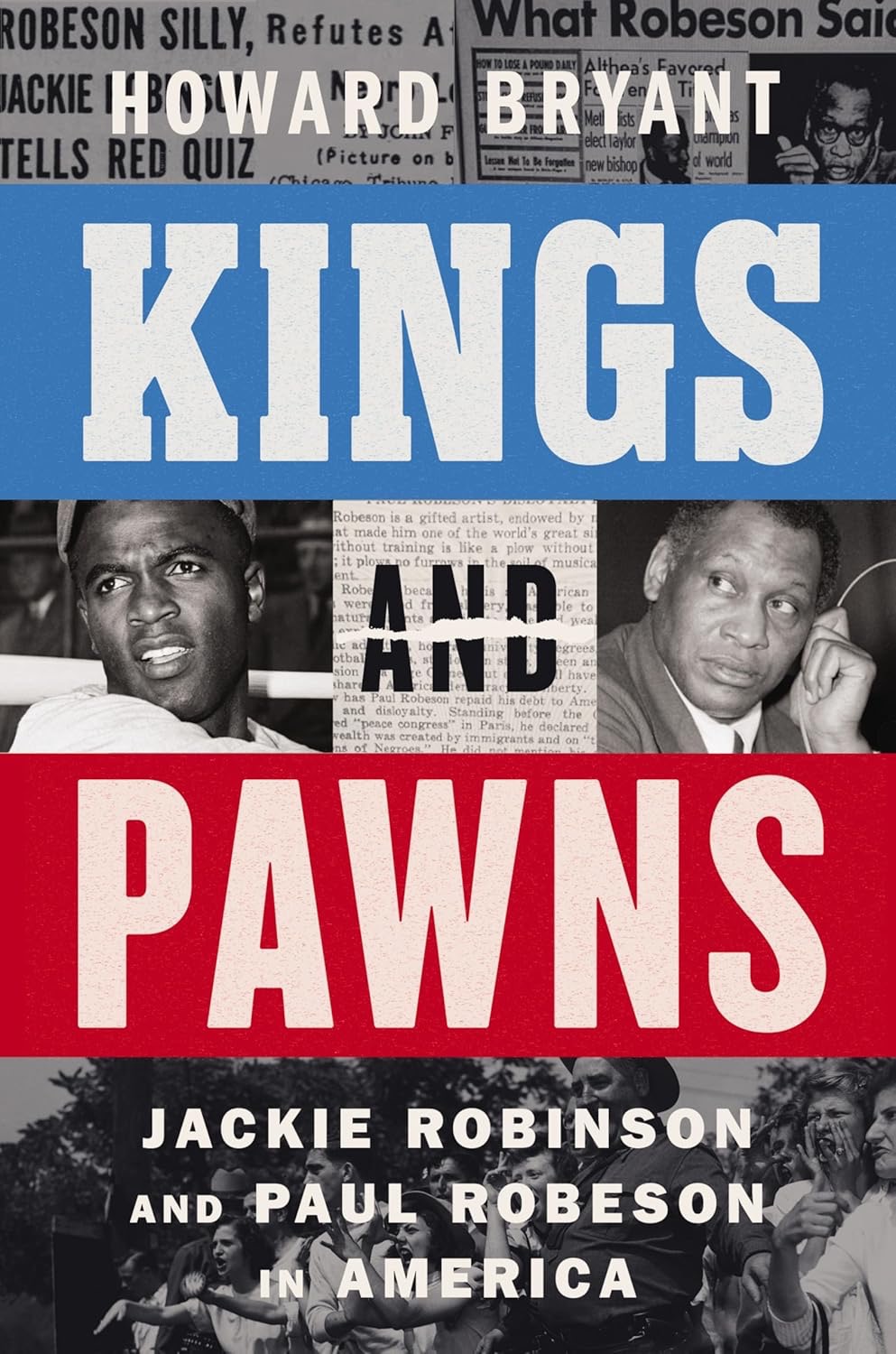
The years 1945 to 1953, when America transitioned from the Great Depression and the politics of World War II into a cold war with the Soviet Union, shaped both domestic and foreign policy. But overshadowed by the explosive years that would follow, this critical period has largely been treated as dormant Black history. Historians have tended to view the 1954 Brown v. Board of Education Supreme Court decision, the 1955 murder of Emmett Till, and Rosa Parks’s subsequent defiance of segregation as the springboards to the modern civil rights movement—yet these in-between years had a profound effect on Black America.
Jackie Robinson and Paul Robeson were central to this overlooked period. Both men served as a prologue of sorts. For the remainder of the 20th century and beginning of the 21st, they were the early prototypes of a new template—the prominent Black entertainer as national political spokesperson. In the 19th century, the voices of Black leadership were the abolitionists and educators, orators, and clergy.
Today, the entertainers, actors, and professional athletes enter the political maelstrom and illustrate Du Bois’s notion of double consciousness, performing for white mainstream audiences while being expected to both advocate for Black issues politically and represent America at home and abroad, a conflict perfected during the Cold War. No race of people have been so politically overmatched. Malcolm X would refer to them as “puppets.”
Through countless published biographies over several decades, Robinson’s 1949 testimony against Robeson on Capitol Hill had long sat in plain sight, explored in only a page or two but usually by a single sentence—Jackie Robinson testified against Paul Robeson—an exposed root on the beaten path of the story of baseball integration.
The exposed root sat unbothered, to be stepped over and never tripped upon. As a professional who had traveled that road in short-, medium-, and long-form journalism for decades, how many times had I stepped over it, muscle memory reminding me to lift one foot over the other without questioning what it was, why it was there, and what it might lead to? And how many times had I read the Jackie Robinson story and realized the entire narrative was constructed through the perspective of one man: Branch Rickey?
Why was the exposed root so easily stepped over? Robinson and Robeson were, along with Joe Louis, Jack Johnson, and Jesse Owens, two of the five greatest Black athletes over the first half of the 20th century. Add to Robeson’s resume a law degree from Columbia, an international concert singer, a groundbreaking stage and screen actor, and he was nothing less than a titan. The root needed pulling.