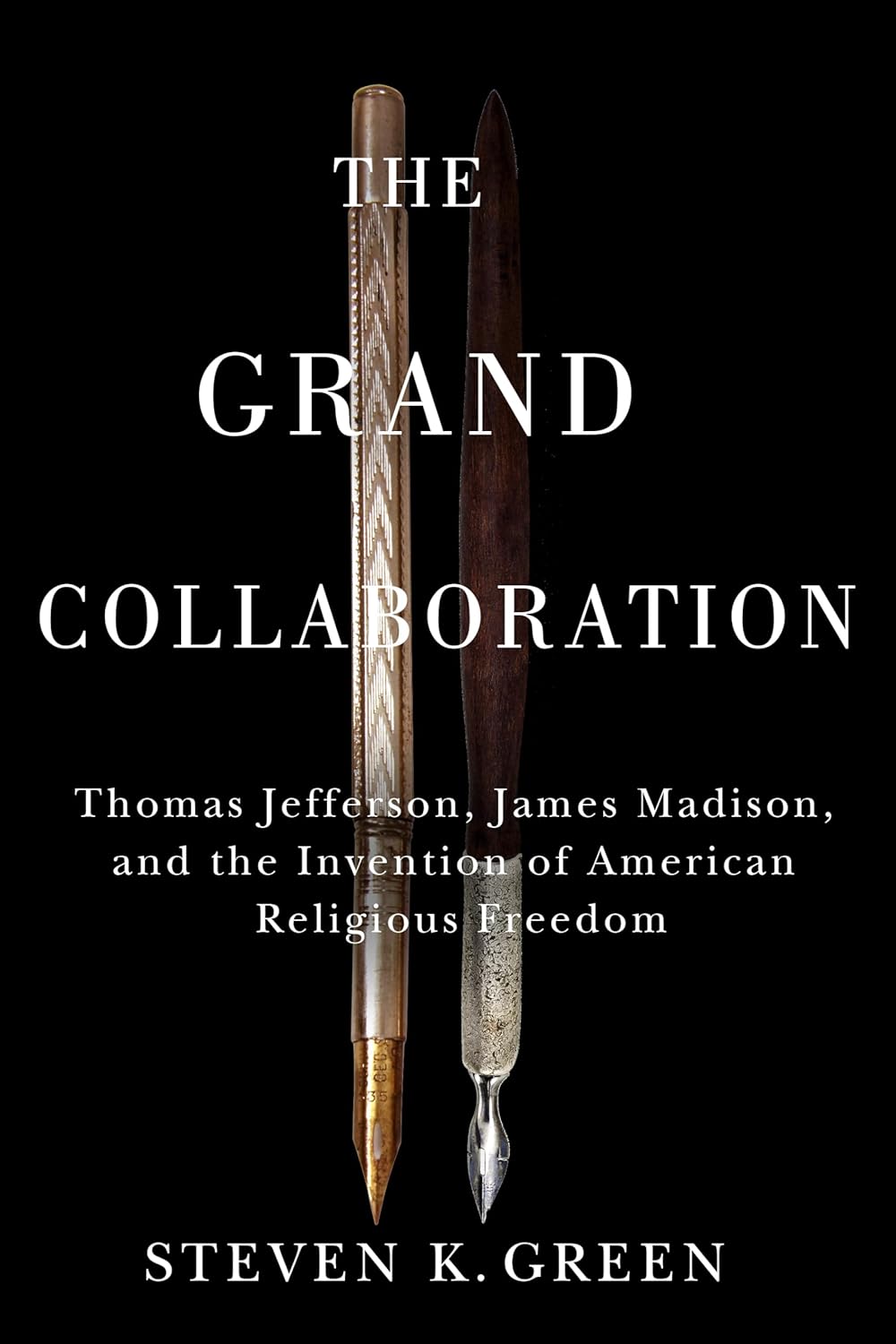
Stephen K. Green’s The Grand Collaboration: Thomas Jefferson, James Madison, and the Invention of American Religious Freedom explores the long and fruitful partnership between these two Virginians. Green recognizes that founders other than Jefferson and Madison helped craft constitutional provisions and laws concerning religious liberty and church state relations in the era, but he clearly thinks that these two founders matter the most. They, as the title suggests, may thus be credited with “the invention of American religious freedom,” an idea which, in his mind, includes the strict separation of church and state.
Early Collaborations
Green begins his book with a helpful account of religious liberty and church-state relations in America from the early colonies (especially Virginia) to the Revolutionary era. But the story really begins after Virginia declared independence and the Virginia Convention appointed a committee to create a bill of rights. George Mason took the lead in crafting this document, and his draft of Article XVI guaranteed religious toleration for Virginia’s citizens. In one of his first important public acts, Madison objected to the use of “toleration” in the article, proposing instead that it be amended to make it clear that “all men are equally entitled to the full and free exercise of religion according to the dictates of conscience.” This shift from religious toleration to protecting the natural right to the free exercise of religion was occurring throughout the states, and there is no question that Madison and Jefferson heartily embraced and encouraged it.
Article XVI, which was approved in June of 1776, guaranteed religious liberty, but it did not end state support of the Anglican Church. Religious dissenters were not satisfied with this result, so the General Assembly responded by passing legislation exempting them from laws requiring church attendance, regulating “modes of worship,” and paying ecclesiastical taxes. But an established church remained, and Jefferson and Madison remained opposed to even this mild establishment.
Yet some Virginians continued to favor religious establishments. In 1784, the General Assembly debated Patrick Henry’s “Bill Establishing a Provision for Teachers of the Christian Religion,” which would have, with a few exceptions, taxed individuals to support the churches to which they belonged. The bill likely would have passed if Henry had not been elevated to the governorship, which at the time had little power. On Christmas Eve of 1784, the legislature voted to postpone taking action so that the bill could be printed and citizens could comment on it.