In 1990, in an essay entitled “The Good Work of America” that went unpublished at the time, McCullough had written, “We’re better off doing what we do best. What we’ve excelled at for a very long time is making things, building, solving problems. And educating our children.” He added, “Our public schools and great universities have long been considered the best in the world. And if our past can teach us anything, it is that education—second to none and open to all—has been our salvation, our making. That, too, has been part of the work of America, the good work of America.”
This praise moves my American heart. McCullough has spent his life thinking about what the past can teach us, and here are some choice appetizers from the collection, developing the titular thesis:
History is—or should be—the bedrock of patriotism. Not the chest-pounding kind of patriotism but the real thing, love of country.
Indifference to history isn’t just ignorant, it’s rude. It’s a form of ingratitude.
To be indifferent to George Washington is to miss the point about who you are, who we are, and how we got to be where we are. We are all in his debt.
These points are worth repeating. McCullough praised the American education system in 1990, but fifteen years later, he gave a commencement speech at Hillsdale College with the title, “Knowing Who We Are.” It included this dark sentence: “Unfortunately, we are raising a generation of young Americans who are by and large historically illiterate.” He gives an example. He opened a class of seniors, all history majors, at an Ivy League school, with the question, “How many of you know who George C. Marshall was?” None did.
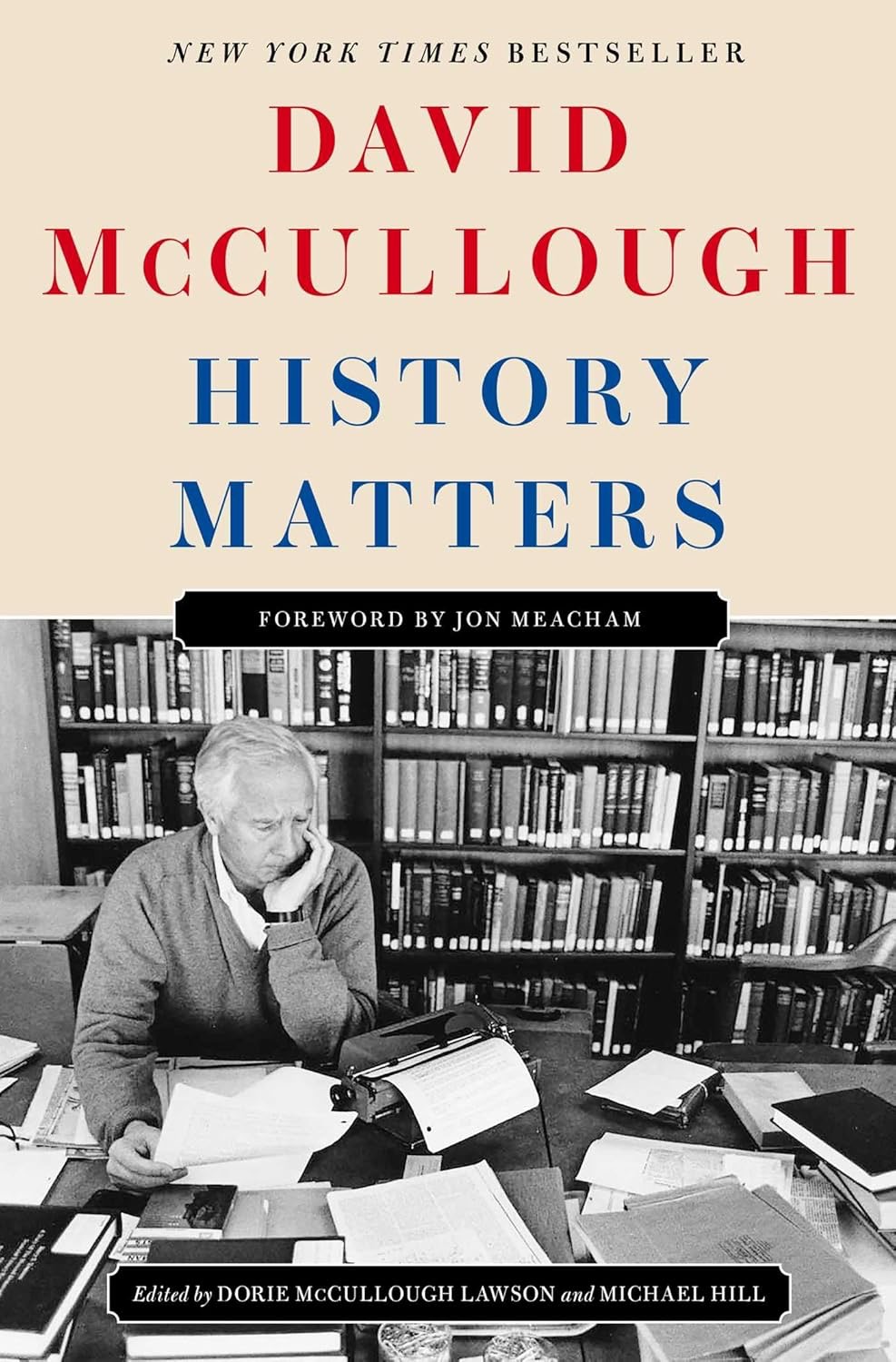
History Matters could be taken as a pun. Not only does the collection urge us to think of history as a kind of knowing that belongs in the education of the free person, but it also contains short specimens of his own writing on a wide range of historical matters. George Washington’s miraculous extraction of his Army from near-certain destruction after their defeat at Brooklyn. Three figures in the history of Yale University: the painter John Trumbull; the polymath, abolitionist, and Yale President Ezra Stiles; and Manasseh Cutler, the man most responsible for the first university in the new state of Ohio. There are many such diverse and delightful narrations in the slim volume: “history matters,” if I may be allowed the solecism.