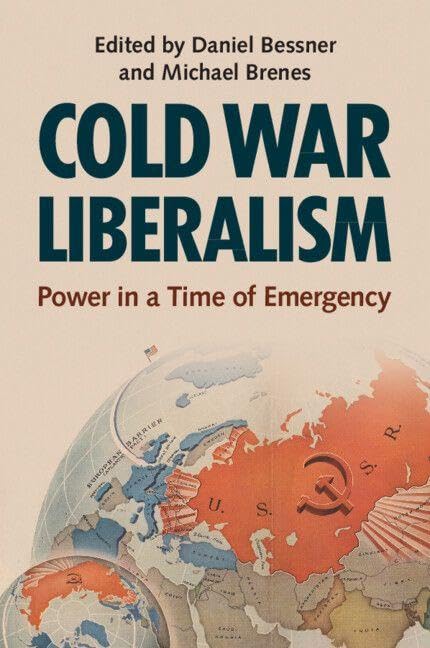
Erik Baker: I thought that we could start by defining our terms. Liberalism is one of the great contested categories of our political vocabulary. Everyone has their own idea of what it means. For the purpose of this book, what is liberalism? And what is Cold War liberalism specifically?
Daniel Bessner: You can find traces of any idea very far back in history. Larry Siedentop, in his book Inventing the Individual: The Origins of Western Liberalism, traces liberalism back to ancient Christian thinkers like St. Paul and St. Augustine, who emphasized the individual’s connection to God. I identify the origins of contemporary liberalism in the period after the French Revolution of 1789 — I think that liberalism emerged in reaction to the excesses of the Terror committed by Robespierre and others. But I do think that it gets very slippery when you focus only on ideas. You always need to ground political analysis in lived realities. You can believe whatever you want, but if it’s not connected to any social movement, it’s really just another form of living in your mind.
Our book responds to a recent resurgence of interest in Cold War liberalism in particular. Cold War liberals, I argue, are socialists, social democrats, and progressives who were transformed by the experience of the 1930s. During the Great Depression, apparently irrational bank runs and financial panics seemed to demonstrate that the masses could be illogical and make decisions that weren’t in their own interest. Even more important than that is what happened abroad — in particular, the rise of Nazism in Germany, a country which was really viewed, particularly among elites, as the center of intellectual culture. The rise of Nazism underlined to many Americans, as well as exiles who had fled Germany, that the masses couldn’t be trusted.
Cold War liberals argued, first with the rise of Nazism and later during the postwar confrontation with the Soviet Union, that the state of emergency made it legitimate for liberals to use illiberal actions to save liberalism. Once the Soviet Union collapsed, ordinary politics could return. But I think that time has proven that supposition incorrect. The founding of institutions like the National Security Council (NSC), the Central Intelligence Agency (CIA), the Department of Defense (DOD), the National Security Agency (NSA), and other groups, gave us an executive branch that was designed to essentially be free from not only public interference but also congressional influence. Cold War liberalism is, to my mind, the founding ideology of the American empire.