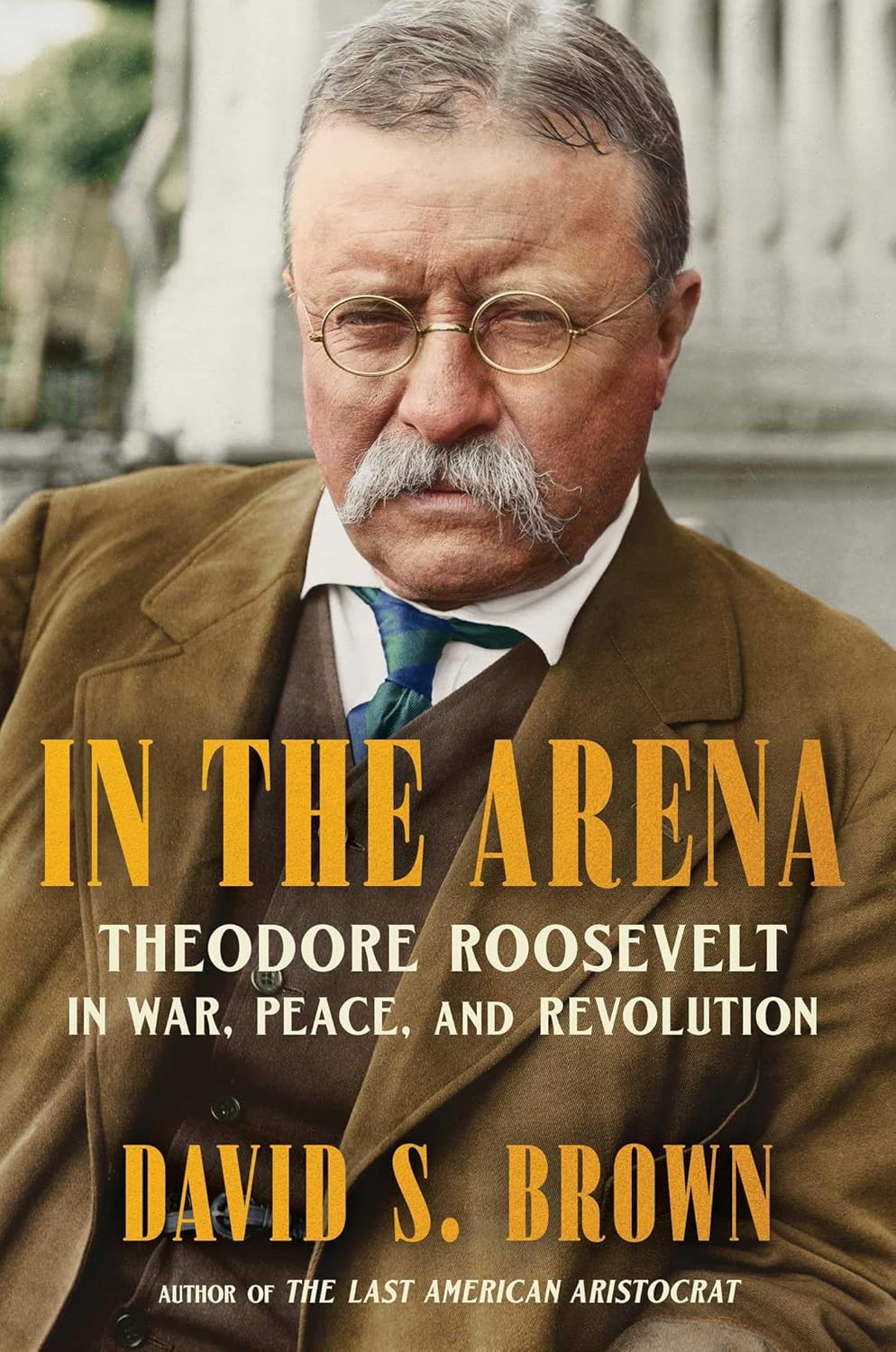
In contrast to the sectional complexions of Jefferson’s and Lincoln’s respective constituencies, “TR’s great political strength,” so his cousin Nicholas Roosevelt once observed, “lay in his millions of devoted followers, especially in rural and small town America. In a sense he was the first truly national political hero.”
The power of Roosevelt’s popularity stemmed, ironically, from a raft of contradictions. Though a silver spooned Manhattan dandy born into a wealthy merchant and banking family, he lived for extended periods after college (Harvard, naturally) on a cattle ranch in the Dakota Territory, became an unlikely military hero in the Spanish-American War, and, despite endorsing martial glory as a “strenuous life” antidote to the “ignoble ease” offered by a highly commercialized civilization, was the first American to receive the Nobel Peace Prize.
Above all, he represented to numerous constituencies concerned with an economy dominated by factory owners and financiers the dreamy promise of a pre-capitalist hero—hunter, warrior, explorer—who might yet infuse the country with an updated iteration of the old frontier ideals.
Domestically, Roosevelt’s progressive reforms—breaking up dozens of monopolies, modifying railroad rates, setting aside public lands for conservation—cut against the long run of industrial oligarchy enjoyed by assorted oil, timber, and coal kings in collusion with their congressional retainers.
“We demand,” TR barked, “that big business give the people a square deal”; this Square Deal liberalism served as a corrective to classical (unregulated, let-the-buyer-beware) liberalism, thus anticipating a cluster of future government public assistance programs, including Franklin Delano Roosevelt’s New Deal, Harry Truman’s Fair Deal, and Lyndon Johnson’s Great Society. By turns loathed and distrusted by any number of plutocrats—“We bought the son of a bitch,” complained the disgruntled steel tycoon Henry Clay Frick, “and then he didn’t stay bought”—Theodore Roosevelt was the first president to attack the problem of industrial fiat.
In foreign affairs, TR presided over America’s emergence as a global power. Leading a volunteer cavalry unit up Kettle Hill in Cuba, he earned his spurs in a war against a fading Spain that brought the island, an “empire of sugar,” into the expanding U.S. sphere; as president he oversaw the conquest of the Philippine Republic, a struggle that foreshadowed the United States’ hit-or-miss entry into future conflicts in Asia against Japan, North Korea, and North Vietnam.
Schooled in social Darwinism, Roosevelt wielded a big stick diplomacy in the Western Hemisphere that betrayed a barely concealed disdain for Latin peoples not atypical for its time. His great achievement in this corner of the world—construction of the Panama Canal—is inescapably paired with the controversial Roosevelt Corollary to the Monroe Doctrine, by which TR announced America’s right to monitor the internal affairs of the Caribbean countries in the manner, so he told Congress, “of an international police power.”