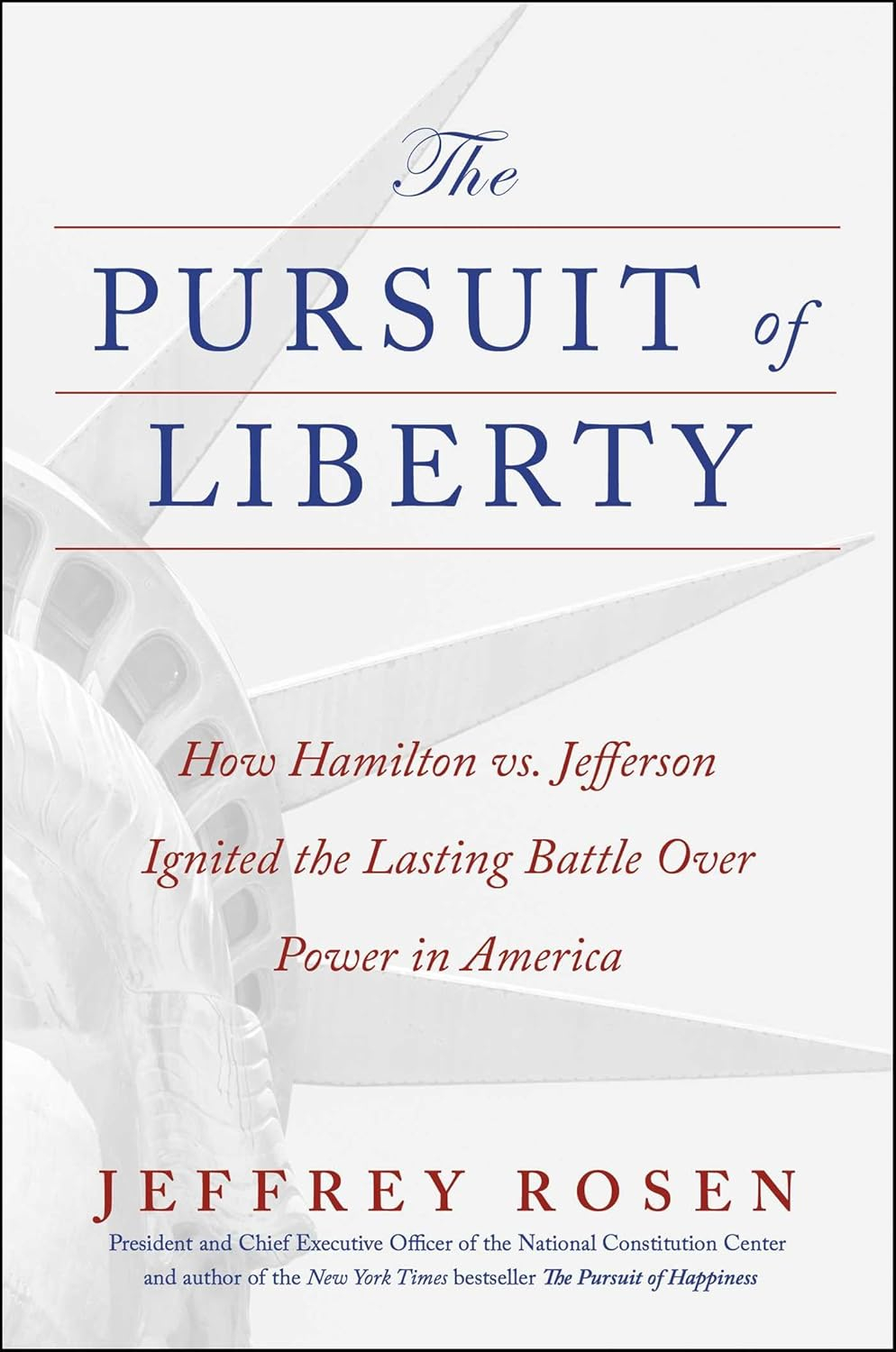
The legacies of Alexander Hamilton and Thomas Jefferson have had an oversized influence on American political history. As important as their individual and distinct contributions to the formation of the American political order have been, their rivalry has had a lasting effect on American political thinking and conduct. In The Pursuit of Liberty: How Hamilton vs. Jefferson Ignited the Lasting Battle Over Power in America, Jeffrey Rosen argues that American political history can be understood as a continued tension between Hamiltonian and Jeffersonian ideas. Rosen does not take sides in this ideological competition; his greater concern is how it has served the health of the American regime.
Both Founders have their virtues and vices. Rosen demonstrates that their greatest contribution has been to pull the factions of American politics into their respective ideological orbits. Just as Hamilton and Jefferson checked and balanced each other, their competing legacies create something like ideological boundaries, a field of play that moderates American politics. When one side begins to push too far in one direction, the other side pulls American politics back to the other side, keeping political conduct and thinking moderate, and liberty and order balanced. Ordered liberty is endangered when American politics leaves the playing field, veering outside of the Hamiltonian-Jeffersonian equilibrium.
Rosen’s conclusion may seem odd at first glance, given the seemingly irreconcilable principles and political theories of Hamilton and Jefferson. From the inception of their two competing political parties (the Federalists and Democratic-Republicans) and bitter personal disputes, their opposition would seem to represent an either-or choice. Rosen, however, illustrates instances when synthesis between Hamiltonianism and Jeffersonianism was created by thinkers and statesmen. In the nineteenth century, for instance, Abraham Lincoln was inspired by Hamilton’s opposition to slavery and insurrection and his support for nationalism, an undivided nation. Lincoln was also wedded to Jefferson’s pronouncement of liberty and equality in the Declaration of Independence. His opposition to slavery was partly Hamiltonian and partly Jeffersonian. Rosen suggests that “Lincoln insisted that Hamilton’s Constitution should be interpreted in light of Jefferson’s Declaration.”
Forward into the early twentieth century, Teddy Roosevelt’s and Herbert Croly’s New Nationalism sought to reconcile Hamiltonian “big government” means with Jeffersonian egalitarian ends. Franklin D. Roosevelt and George W. Bush also combined Hamiltonian and Jeffersonian characteristics. The former promoted a more democratic America by using the bold and expansive central government advocated by Hamilton. Roosevelt criticized the Supreme Court for adhering to a Jeffersonian strict constructionism that stood in the way of empowering a Hamiltonian strong executive. He wanted the Court’s justices to follow Hamilton’s broad construction of the Constitution to validate New Deal legislation that served Jeffersonian ends. George W. Bush embraced a Hamiltonian unitary presidency in foreign affairs as an instrument of spreading democracy and the empire of liberty, a Jeffersonian end.