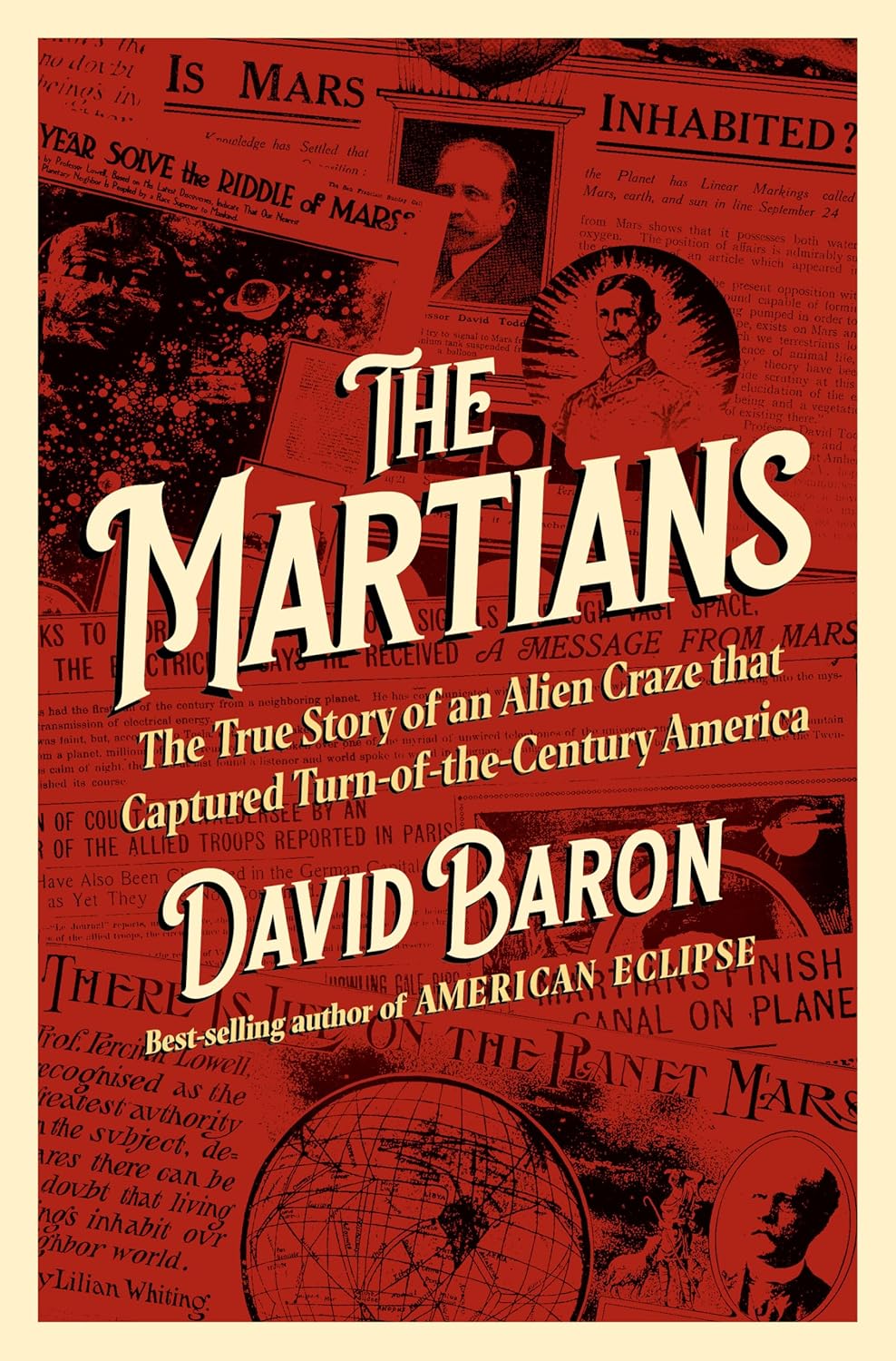
The Martians, David Baron’s riveting exploration of the Mars craze of the late 1800s and early 1900s, is a case study in the formation of unfounded beliefs. The tale begins on August 23, 1877, when the distinguished director of Milan’s Brera Observatory, Giovanni Schiaparelli, took advantage of the fact that Mars was making an unusually close approach to Earth. Schiaparelli maneuvered his telescope in such a way as to get clear looks at Mars, with the goal of producing a detailed map of the planet’s surface. As it happens, Schiaparelli was color-blind, which may, Baron suggests, “have enhanced his perception of shape and contrast.” During the fall and winter of 1877, Schiaparelli made his map. He found dark and light areas, as others had; at the time, these were widely taken to be oceans and continents, and Schiaparelli saw them as such. But he also saw, apparently for the first time, a large number of straight “narrow streaks,” hundreds or even thousands of miles long, “that appeared to connect the seas to one another,” Baron reports. Sometimes the streaks disappeared. Sometimes they were as “strongly marked as a pen line,” Schiaparelli observed. Sometimes they seemed to double; Schiaparelli called that process “gemination.” Incredulously, he asked a colleague: “What could all this mean?”
Because the lines seemed to connect Martian oceans, Schiaparelli referred to them as “canali,” a word that means “channels” in Italian, but that was mistranslated as “canals” in English. In 1882, The Times of London ran a dramatic headline: “Canals On The Planet Mars.” Astronomers around the world tried to confirm Schiaparelli’s dramatic findings. Most of them saw no lines in 1884, 1886, and 1888, when Mars was also close to Earth. But in 1892, astronomers in Peru, California, and France did indeed see the lines. The world was intrigued. Were there living creatures on Mars, constructing canals? The New York Herald wondered: “Are the so-called ‘canals’ really signals which are being exhibited to us, or are they made to connect all the big seas with another?” The Boston Daily Globe speculated: “Who shall say that some day a delegation of Marsonians will not visit the earth.” (The term “Martians” came into widespread use a bit later.)
Percival Lowell, scion of the famous Lowell family (and brother of Lawrence Lowell, later to become president of Harvard), was intrigued. Born in 1855, Lowell was looking for direction in life. He turns out to be the hero, or at least the protagonist, of Baron’s story. He asked the director of Harvard’s Observatory to help him find the “most modern charts or drawings of Mars,” including Schiaparelli’s. He wanted to explore Mars on his own. Having procured an advanced telescope (he had a ton of money), he started to do so in earnest. In his late thirties, he relocated from New England to a pine forest in the Southwest, where the view of Mars would be better.