Guitarist Wayne Moss still remembers the session. “She had a good feel for R&B and did a fabulous job on a country song,” he told me. “She was singing as though she were a female Ray Charles. She was singing it as though it were R&B.” The other musicians were impressed too. “Musicians hear so much here that nothing moves them,” songwriter Bob Jennings, who was there, told The Music Reporter’s Nola Jaye. “And some of these people had started working on other sessions at nine a.m. the day before . . . It was three a.m., and they laid aside their instruments and applauded.”
Esther was growing as an artist, and one day she stopped to get gas at a Phillips 66 station, looked at the sign, and found herself pondering a name change. Esther Phillips. She liked the way it sounded. When the album Release Me! Reflections of Country and Western Greats was released in December 1962, she was billed as “Little” Esther Phillips.
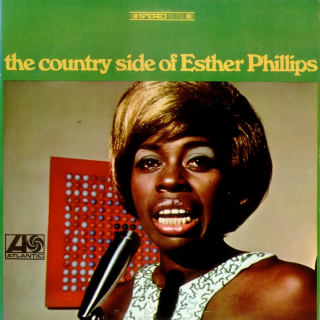
You can guess what happened next. If Nashville wasn’t ready for one country song by a Black woman singing in a candidly Black style, it wasn’t ready for a whole album. And, frankly, neither was anyone else. After Phillips’s next release, “I Really Don’t Want to Know,” topped out at number 61 on the charts, the album went nowhere, and Lenox Records soon went bankrupt. The album got a second chance in 1966 when the major label Atlantic, which had recently signed her, rereleased it as The Country Side of Esther Phillips. But this version flopped too.
And that was it for Esther Phillips’s Nashville career. She was adrift for much of the rest of the sixties, struggling with drugs and spending three years in a California rehab program. She also suffered through a bad marriage and found herself making slick, mostly forgettable pop-jazz for Atlantic. But along with the lows there were some extraordinary highs. An understated version of the Beatles’ “And I Love Her,” retitled “And I Love Him,” was a hit in 1965. The Beatles liked it so much that they flew Phillips to London and put her on TV. For years afterward, whenever Paul McCartney was asked what his favorite Beatles cover was, he pointed to Phillips’s.