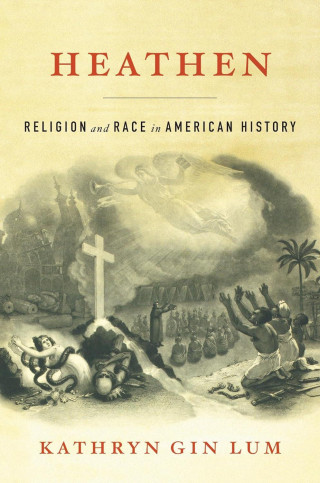
“Heathens” were understood to be people who worshiped anything but the one true God, misdirecting their energies to the worship of nature, idols, or their own dead. Originally, the term referred to those Europeans who lived on the edges of society and rejected the new Christian religion, choosing instead to worship the old gods like Thor and Odin. Over time, the term expanded to include anyone who fell outside of the Abrahamic traditions – not Christians, not Muslims, not Jews. Europeans and Euro-Americans read all of these “heathens” through the same lens, as people who didn’t know how to take care of their bodies or their lands, and who needed Christians to help. Activated by the Great Commission’s charge to “make disciples of all nations,” missionaries went overseas to try to do just that.
But it was one thing to go to the “heathen,” and quite another when the “heathen” began arriving on America’s shores. Though some ministers continued to see the arrival of the Chinese as an opportunity to convert them, others, like Blakeslee, began to claim that immigration restriction was necessary to keep America itself from becoming heathenized. The Great Commission needed to become the Great Omission, omitting anyone who threatened to replace the white American Christian way of life with something else. To think otherwise, Blakeslee alleged, was “false Christianity, false benevolence, false patriotism.” America needed to be a fortress. True “patriots” needed to defend that fortress in order to preserve a way of life that the rest of the world was supposed to emulate – but only from a distance.
There was a crucial economic component to anti-Chinese hostility. White laborers worried about Chinese competition and feared that capitalist elites were bringing Chinese workers into the country to take the place of Black labor after the Civil War, pricing white laborers out of existence. This, too, anticipates the “Great Replacement” theory’s belief that “American elites are conspiring to replace so-called real Americans with immigrants from poor countries.”
But fear of economic competition from the Chinese also had religious roots. Heathenism was supposed to be the reason for the negative qualities the Chinese brought to America. Anti-Chinese demagogues claimed that Chinese laborers were willing to live on next to nothing, crowding into tenements in Chinatown and making meals from rats, because their “heathen” religion taught them to devote all their energy and earnings to dead ancestors. Focusing on their dead, they supposedly neglected their living, bringing down the quality of life wherever they went. As Reverend William Lobscheid, pastor of San Francisco’s United German Evangelical Lutheran St. Mark’s Church, put it in 1873, “Is this lack of public spirit not a proof that you are Pagan?”