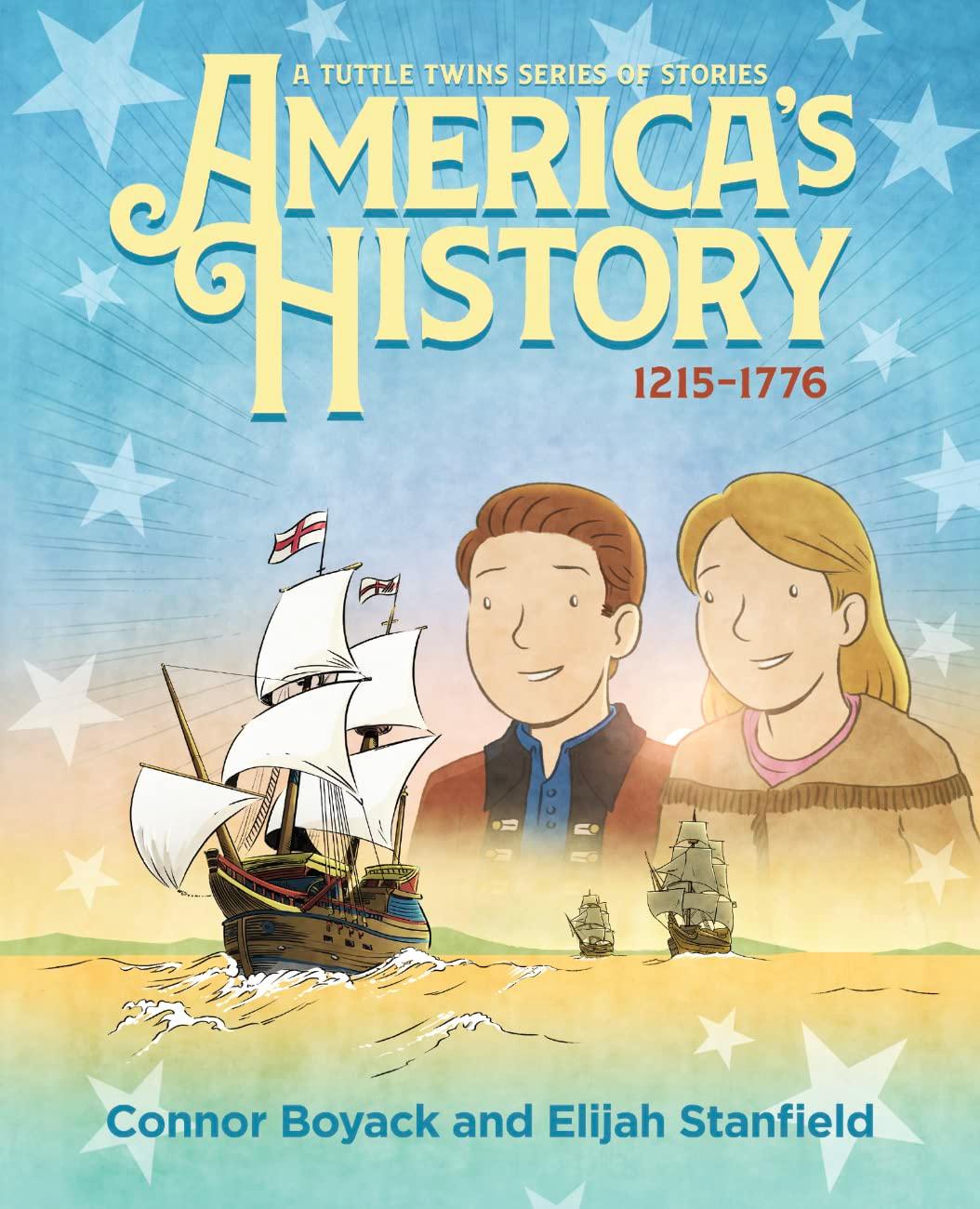
One striking moment comes when the kids are learning about the French-Indian War, in which the British and French colonial governments enlisted some Native American tribes to fight one another. The uncle’s retelling of the story to Ethan and Emily features one of the few actual on-page depictions of violence, including a lurid illustration, which makes sense when describing a war. However the depiction is not of the great expulsion and elimination of the many pre-Columbian civilizations of North America, it is of course an illustration of a native killing some poor Europeans.
The conflict begins when the French claim rich Ohio river valley land that was already claimed by colonial “land speculators,” and we learn a speculator is just someone who is “Guessing about the future value of something,” and therefore it’s “like investing.” The competing French and colonial claims lead to conflict, with George Washington leading a detachment into the valley since his family was one of the wealthiest speculators: “the Washington family believed the Ohio River Valley was going to be part of the colonies; so claiming it, and selling it to the new settlers, would make them very wealthy.” So war it is, to protect a rich family’s wealthy property bets!
The Americans (good colonists) heroically defeat the French (bad colonists) with native help, but then we learn the treacherous native leader was “only using the Americans so he could get revenge on the French.” What a native leader could want revenge against the French for, we don’t learn in this alleged history book! But even though the French had surrendered, the “warriors killed Commander Jumonville and other Frenchmen with their tomahawks before Washington could stop them.”
The illustration itself shows a victorious native holding up a bloody knife surrounded by corpses, while the kids look on in horrified disbelief at the violence. In the description of the battle, Emily says, “I don’t like to hear about George Washington killing people.” This is a bit laughable, especially in the context of a depiction of horrible Native American violence, since Washington is recorded as being nicknamed “Conotocaurius” by the Iroquois people, which is commonly translated as “Town Destroyer” and was sometimes used by Washington himself. One wonders if the author is actually unhappy to hear about Washington killing other white people. The twins agonize over the Boston Massacre, but the book has no room for the kids to learn about, for example, how many native peoples were removed from their lands in the period described, like the literal Massachusetts, being the Massachusett tribe which now barely exists but whose name we took, along with everything, everything else.