Filter by:

Filter by published date

Viewing 91–120 of 473 results. Go to first page
Tom Wolfe in profile against the New York City skyline.

The Electric Kool-Aid Conservative

Tom Wolfe was no radical.
The cover of "The Deadline" by Jill Lepore.

The Hold of the Dead Over the Living

A conversation with Jill Lepore about the past decade — “a time that felt like a time, felt like history.”
Painting of waves crashing in the ocean by Winslow Homer

After Melville

In every generation, writers and readers find new ways to plumb the depths of Herman Melville and his work.
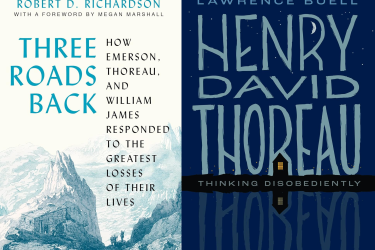
Books "Three Roads Back" and "Henry David Thoreau."

To Walden

Two new books attempt to grasp Thoreau’s seeming contradictions without reconciling them too easily.
Greek style illustration of Edith Hamilton and mythical figures.

The Latin School Teacher Who Made Classics Popular

A new biography of Edith Hamilton tells the story of how and why ancient literature became widely read in the United States.
Montana poster from the Works Projects Administration.

How WPA State Guides Fused the Essential and the Eccentric

Touring the American soul.
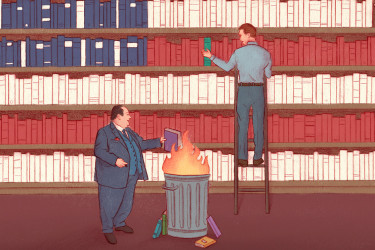
A librarian protects a book from a fat man in a suit who is burning books that don't look "American."

How Librarians Became American Free Speech Heroes

In the past and present, librarians have fought book bans and censorship.
Another text is visible beneath a ripped piece of writing

How America's First Banned Book Survived and Became an Anti-Authoritarian Icon

The Puritans outlawed Thomas Morton's "New English Canaan" because it was critical of the society they were building in colonial New England.
original

Edgar Allan Poe’s America

Tracing the life of the author who seemed to be from both everywhere and nowhere.
A mother sits behind a sign reading, "I have a Bible, I don't need those dirty books."

The Great Textbook War

What should children learn in school? It's a question that's stirred debate for decades, and in 1974 it led to violent protests in West Virginia.
The covers of "Romance in Marseille" and "Amiable with Big Teeth" by Claude McCay over a blue blackground splattered with paint.

Zeal, Wit, and Fury: The Queer Black Modernism of Claude McKay

Considering the suppressed legacy of Claude McKay’s two “lost” novels, “Amiable with Big Teeth” and “Romance in Marseille.”
Shelby Foote with a drawing of a Civil War battle superimposed over him.

The South’s Jewish Proust

Shelby Foote, failed novelist and closeted member of the Tribe, turned the Civil War into a masterpiece of American literature.
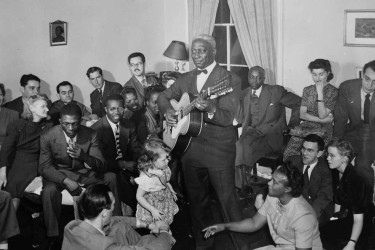
American blues singer and guitarist Leadbelly performs for a room full of people, 1940.

Is the History of American Art a History of Failure?

Sara Marcus’s recent book argues that from the Reconstruction to the AIDS era, a distinct aesthetic formed around defeat in the realm of politics.
Charles Dickens as he appears when reading, Harper’s Weekly (December 7th, 1867).

A Christmas Carol In Nineteenth-Century America, 1844-1870

What were Americans' immediate responses to "A Christmas Carol," and how did Dickens' reading tours and eventual death reshape its meaning?
Covers of popular history books.

Who Is History For?

What happens when radical historians write for the public.
Portrait of a girl wearing a red coral necklace.

The Labor of Polyps and Persons

The meaning of coral jewelry in nineteenth-century America.
Franz Kafka

How Franz Kafka Achieved Cult Status in Cold War America

And the origins of the term “Kafkaesque.”
Tennessee Williams

How Thomas Lanier Williams Became Tennessee

A collection of previously unpublished stories offers a portrait of the playwright as a young artist.
Henry David Thoreau with a propeller cap.

Henry David Thoreau Was Funnier Than You Think, Particularly on the Subject of Work

On the necessary “deep sincerity” of dark humor.
Historic marker for the 1892 lynching of Robert Lewis at Port Jervis.

Death by Northern White Hands

On Philip Dray’s “A Lynching at Port Jervis.”
Illustrated portrait of Don DeLillo against a firey background.

Secret Histories

Don DeLillo's Cold Wars.
Cormac McCarthy.

Cormac McCarthy’s Unforgiving Parables of American Empire

He demonstrated how the frontier wasn’t an incubator of democratic equality but a place of unrelenting pain, cruelty, and suffering.
Sedat Pakay, James Baldwin, Istanbul, 1966.

James Baldwin in Turkey

How Istanbul changed his career—and his life.
Daguerreotype of a young woman, with her head resting on her hand.

In Love with a Daguerreotype

A nineteenth-century twist on love at first sight.
Otsego Hall, home of James Fenimore Cooper.
original

Pieces of the Past

Dispatches from a spine-tingling day of visits to the places where James Fenimore Cooper, Herman Melville, and Thomas Cole created their most famous works.
Panting of a woman lounging with a book, titled “Dolce far niente” (The Sweetness of Doing Nothing), by Auguste Toulmouche, 1877.

We’re Distracted. That’s Nothing New.

Ever since Thoreau headed to Walden, our attention has been wandering.
Cover of "Gravity's Rainbow," depicting a orange-red sky over a small city.

History Is Hard to Decode

On 50 years of Thomas Pynchon’s “Gravity’s Rainbow.”
The Armed Services Edition of the book "The Grapes of Wrath."
partner

America Fought Its Own Battle Over Books Before it Fought the Nazis

Recent years have witnessed a record number of challenges against books, especially in school libraries. But attempts to ban certain books isn't new in the U.S.
Painting of flowers called "The Island Garden," by Childe Hassam, 1892.

A Wiser Sympathy

How Emily Dickinson, scientists, and other writers theorized plant intelligence in the nineteenth century.
From left to right, Langston Hughes with Charles S. Johnson; E. Franklin Frazier; Rudolph Fisher and Hubert T. Delaney.

Why Harlem? Considering the Site of “Civil Rights by Copyright,” 100 Years Later

The confluence of Black modernity, self-determinism, and belongingness of Harlem's housing.

Filter Results:

Suggested Filters:

Idea

Person