Filter by:

Filter by published date

Viewing 151–180 of 313 results. Go to first page
Voters casting ballots in 2008.

How Letting Felons Vote Is Changing Virginia

Governor McAuliffe has embarked on a campaign to grant clemency more often, and to restore the civil rights of convicted felons.
Whites at a Trump campaign rally.

Does the White Working Class Really Vote Against Its Own Interests?

Trump has revived an age-old debate about why some people choose race over class—and how far they will go to protect the system.
A prison cell with a television tuned to election coverage.
original

Why Felon Disenfranchisement Doesn't Violate the Constitution

The justification can be found in an obscure section of the Fourteenth Amendment.

How the Kim Kardashians of Yesteryear Helped Women Get the Vote

Now all but forgotten, a group of New York socialites was instrumental to the success of the suffrage movement.
Exhibit

Voting Rights: A Retrospective

Voting, a right not initially enshrined in the Constitution, has been secured, revoked, and contested since the nation's founding era.

original

"What is Sport to You is Death to Us."

In 1867, African-Americans in Virginia stood up for their new political rights in the face of threats from their white neighbors.

History Frowns on Partisan Gerrymandering

On the eve of a major redistricting case at the Supreme Court, a look back at what the nation's founders would have thought.
Suffragists picketing in front of the White House.

Women's Suffrage @100

We date the expansion of voting rights to women in 1920, but the real story is a lot more complex.
Lithograph of the Reconstruction-era Black Senators and Congressmen.

How About Erecting Monuments to the Heroes of Reconstruction?

Americans should build this pivotal post–Civil War era into the new politics of historical memory.
Allegorical lithograph entitled "Reconstruction," by J. L. Giles in 1867.
partner

Why the Second American Revolution Deserves as Much Attention as the First

The first revolution articulated American ideals. The second enacted them.
Reconstruction era political cartoon.

The Political Cartoon That Explains the Battle Over Reconstruction

Take a deep dive into this drawing by famed illustrator Thomas Nast.

Slavery, Democracy, and the Racialized Roots of the Electoral College

The Electoral College was created to help white Southerners maintain their disproportionate influence in national governance.

Why Did White Workers Leave the Democratic Party?

Historian Judith Stein debunks liberal myths about racism, the New Deal, and why the Democrats moved right.
An African American group at the county convention of the Mississippi Freedom Democratic Party in 1964.

Fannie Lou Hamer and the Civil Rights Movement in Rural Mississippi

A primary source set and teaching guide created by educators.

Killing Reconstruction

During Reconstruction, elites used racist appeals to silence calls for redistribution and worker empowerment.
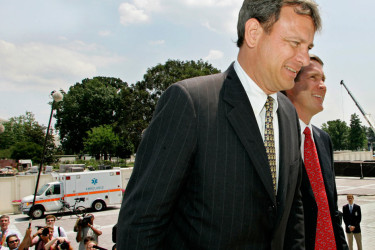
John Roberts in DC with the media taking photos of him walking.

Inside John Roberts’ Decades-Long Crusade Against the Voting Rights Act

Roberts rose from Rehnquist’s clerk to Chief Justice, leading efforts to weaken the Voting Rights Act and redefine voting protections.

How the 2000 Election in Florida Led to a New Wave of Voter Disenfranchisement

A botched voter purge prevented thousands from voting—and empowered a new generation of voting-rights critics.
Photo of Jimmy Lee Jackson.

The Killing of Jimmie Lee Jackson

How a post-Civil War massacre impacted racial justice in America.

The New Racism

A glimpse inside the Alabama State House suggests that the civil rights movement may have reached its end.
Voters at the voting booths in 1945.

Felon Disfranchisement Preserves Slavery's Legacy

Nearly six million Americans are prohibited from voting in the United States today due to felony convictions.
This editorial cartoon from a January 1879 edition of Harper's Weekly depicting a white man misspelling words on a sign announcing Black voters must pass a literacy test, while a Black man looks on laughing.

The Racial History Of The 'Grandfather Clause'

Companies and individuals are considered grandfathered and exempt from new sets of regulations all the time. But the term and the concept dates to a darker era.

The Court & the Right to Vote: A Dissent

How the Supreme Court got it wrong.

SNCC Digital Gateway

A documentary website that tells the story of how young activists united with local people in the Deep South to build a grassroots movement that transformed the nation.

Re-mapping American Politics

The redistricting revolution, fifty years later.

Their Own Talking

Reconsidering Septima Clark’s life challenges many of our ideas about the Civil Rights Movement and women's roles in it.
Kwame Ture at at a 1966 Mississippi Press Conference. Public Domain.
partner

Stokely Carmichael Interview

A field secretary of SNCC discusses the importance of maintaining political power inside communities at the county level.

The Selma March

On the trail to Montgomery.
Photograph of Martin Luther King Jr. speaking into microphones.

Let Justice Roll Down

"Those who expected a cheap victory in a climate of complacency were shocked into reality by Selma."
Political cartoon of Freedman's Bureau agent separating angry whites from defensive freedmen.

The Freedmen's Bureau

“No sooner had Northern armies touched Southern soil than this old question, newly guised, sprang from the earth: What shall be done with slaves?”
The Northampton Election, December 6, 1830, by J.M.W. Turner, c. 1830. A British election taking place in a town square with people waving banners and standing around.

The Tyranny of the Ballot

A man who wants everyone to know his views explains why he’s against voting in secret.
William Goodell in a suit.

William Goodell and the Science of Human Rights

William Goodell was praised by Frederick Douglass for being among the most important opponents of slavery in his time.

Filter Results:

Suggested Filters:

Idea

Person