Person

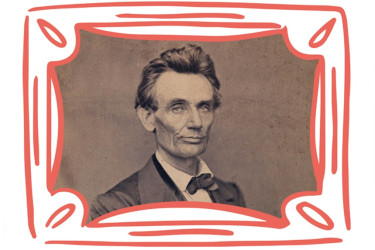
Abraham Lincoln

Related Excerpts

"Declaration of Independence" by John Trumbull

Give Me Independence: On 1776, the Pivotal Year For What Would Become America

Why 1776 became the year Americans declared themselves an independent nation.
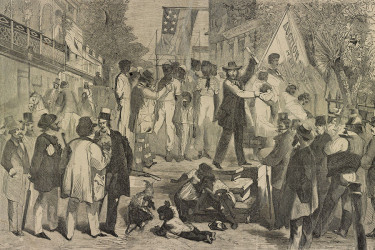
'A slave auction at the South' by Theodore R. Davis, from Harper’s Weekly, July 1861

Speculation in Human Property

The survival of slave trading during the Civil War suggests that enslaved people remained valuable commodities in a time of economic upheaval.
Abraham Lincoln.

Abraham Lincoln’s 1859 Lesson for Some 2028 Democrat

There are parallels between the John Brown raid and the murder of Charlie Kirk. But only one man seized the moment to start changing the course of history.
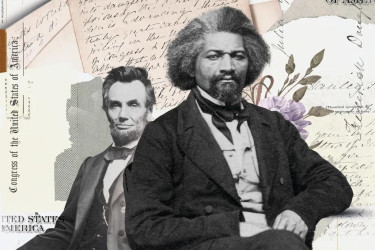
Frederick Douglass and Abraham Lincoln in front of a collage of letters.

When Historians Rediscovered These Frederick Douglass Letters, His Words on Lincoln Surprised Them

In correspondence with an abolitionist in London, the great American orator didn’t hold back when talking about Abraham Lincoln, or the maligned Andrew Johnson.
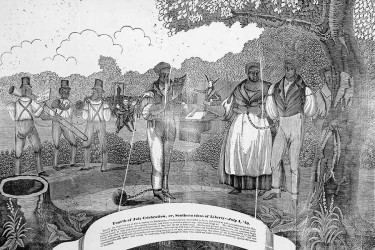
An abolitionist lithograph depicting enslaved people celebrating the Fourth of July while a white judge sits on bales of cotton with his feet on the Constitution, 1840

The Contradictory Revolution

Historians have long grappled with “the American Paradox” of Revolutionary leaders who fought for their own liberty while denying it to enslaved Black people.
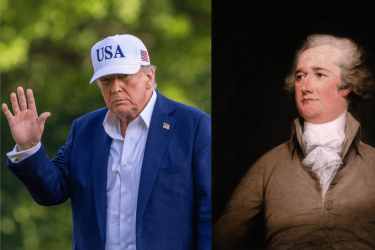
Donald Trump; Alexander Hamilton.

Trump Is Hamiltonian, Not Jacksonian

He believes in Federalist 70’s “Energy in the Executive.”
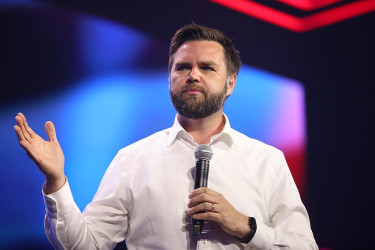
JD Vance

J.D. Vance's Anti-Declaration

Truths self-evident no more.
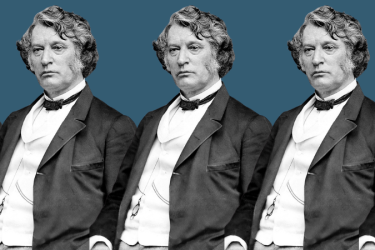
Charles Sumner

How Charles Sumner Convinced Abraham Lincoln and the Union To Take a Stand Against Slavery

The domestic and international dynamics of the early days of the Civil War.

Lincoln's Habeas Corpus Precedent

Ultimately, only a civic culture alert to and upset by abuses of power can safeguard sound republican government.
A photograph of Frederick Douglass imposed on the cover of The Columbian Orator by Caleb Bingham.

The Columbian Orator Taught Nineteenth-Century Americans How to Speak

For strivers like Lincoln, guides to rhetoric had a special currency in the nineteenth century.
Abraham Lincoln

Lincoln's Duel

In the summer of 1842, young Abraham Lincoln’s razor-sharp wit almost got him into a whole heap of trouble.
Church with graveyard.

Divided Providence

Faith’s pivotal role in the outcome of the Civil War.
A drawing of protestors wrestling a tax collector to the ground.

A Prudent First Amendment

Often, the proper scope of the First Amendment can be determined only by considering both text and context.
A Public Health Services physician checking a woman immigrating into the United States for illness.

How the Irish Became Everything

Two new books explore the messy complexities of immigration—from the era of Lincoln to Irish New York.
Caesar's profile is eerily set against the Great Seal of the United States.

US President or American Caesar?

American democracy has been haunted by the spectre of a Caesar-type figure since the birth of the republic. Have such fears ever been justified?
Aurora Borealis painting by Frederic Edwin Church, 1865.
partner

A Nice Metaphor for the Country

On the 1860 Republican National Convention in Chicago.
Protestors and counter-protestors face off holding flags and posters.

Two Americas?

Heather Cox Richardson argues that there are two Americas: one interested in equality, the other in hierarchy. But it's not that simple.
Sheet music depicting a fugitive slave.

Against the Slave Power: the Fugitive Liberalism of Frederick Douglass

Douglass elaborated a political theory attuned to the differential character of law as it applied to slaves and other outlaws.
Chief Justice John Roberts attending the State of the Union.

J. Roberts et al. v. A. Lincoln

As the Supreme Court invents a law to negate all others, Chief Justice John Roberts now ranks just below Roger Taney.
An 1863 illustration from “Le Monde illustré” of formerly enslaved people celebrating the Emancipation Proclamation.

What If Reconstruction Didn’t End Till 1920?

Historian Manisha Sinha argues that the Second Republic lasted decades longer than most histories state and achieved wider gains.