Menu
Excerpts
Exhibits
Collections
Originals
Categories
Map
Search
Category
Beyond
On Americans’ connections to the larger world.
Load More
Viewing 661–690 of 903
Finding a Home for the Last Refugees of World War II
What happened to the last million Eastern Europeans in refugee camps in Germany, who refused to return home, or who had no home to return to.
by
David Nasaw
via
Literary Hub
on
September 15, 2020
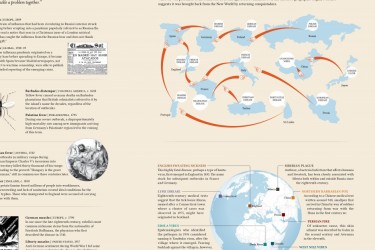
The Name Blame Game
A history of inflammatory illness epithets.
by
Haisam Hussein
via
Lapham’s Quarterly
on
September 14, 2020
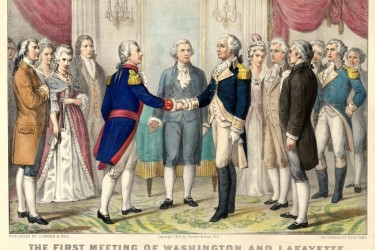
Foreign Support of the American Cause Prior to the French Alliance
Richard J. Werther discusses how being outmanned by the best army in the world led American revolutionaries to look overseas for the help they needed.
by
Richard J. Werther
via
Journal of the American Revolution
on
September 8, 2020
The American Empire and Existential Enemies
Since its emergence in the middle of the twentieth century, the American Empire has been fueled by the search for an enemy.
by
Daniel Bessner
via
Foreign Exchanges
on
September 7, 2020
“Allende Wins”
Chile voted calmly to have a Marxist-Leninist state, the first nation in the world to make this choice freely and knowingly, on September 4, 1970.
by
Peter Kornbluh
via
National Security Archive
on
September 3, 2020
America and Russia in the 1990s: This is What Real Meddling Looks Like
It’s hard to imagine having more direct control over a foreign country’s political system — short of a straight-up military occupation.
by
Yasha Levine
via
yasha.substack
on
August 27, 2020
The (Literally) Unbelievable Story of the Original Fake News Network
In Guatemala, the CIA hired an American actor and two radio DJs to oust a president.
by
Sylvia Brindis Snow
,
Shane Snow
via
Narratively
on
August 27, 2020
The Conceit of American Indispensability
As we mine the 1940s for alternate visions of international order, we must not presume that the US remains the benevolent center of global politics.
by
Sam Klug
via
Boston Review
on
August 18, 2020
The Death and Rebirth of American Internationalism
As the 2020 presidential election nears, internationalists are plotting their return. But they still haven’t learned from the failure of liberal universalism.
by
Edward Fishman
via
Boston Review
on
August 11, 2020
Daughters of the Bomb: A Story of Hiroshima, Racism and Human Rights
On the 75th anniversary of the A-bomb, a Japanese-American writer speaks to one of the last living survivors.
by
Erika Hayasaki
via
Narratively
on
August 5, 2020
Counting the Dead at Hiroshima and Nagasaki
How many people really died because of the Hiroshima and Nagasaki bombings? It’s complicated. There are at least two credible answers.
by
Alex Wellerstein
via
Bulletin of the Atomic Scientists
on
August 4, 2020
How the Failures of the 1919 Versailles Peace Treaty Set the Stage for Today’s Anti-Racist Uprisings
In 1920, like 2020, race became the pivot of a historic turning point.
by
Elizabeth Thompson
via
The Conversation
on
August 3, 2020
It’s Time for the British Royal Family to Make Amends for Centuries of Profiting From Slavery
An empire built on the backs and blood of enslaved Africans.
by
Brooke Newman
via
Slate
on
July 28, 2020
A World “Transfixed”: The International Resonance of American Political Crises
The world's eyes are upon America as it struggles with racism and inequality. This is nothing new.
by
Brooks Swett
via
Muster
on
July 24, 2020
Whose Century?
One has to wonder whether the advocates of a new Cold War have taken the measure of the challenge posed by 21st-century China.
by
Adam Tooze
via
London Review of Books
on
July 22, 2020
Trump Has Brought America’s Dirty Wars Home
The authoritarian tactics we’ve exported around the world in the name of national security are now being deployed in Portland.
by
Stuart Schrader
via
The New Republic
on
July 21, 2020
The Racist Origins of U.S. Policing
Modern policing is linked to overseas colonial projects of conquest, occupation, and rule. Demilitarization requires uprooting that worldview.
by
Julian Go
via
Foreign Affairs
on
July 16, 2020
Sanctuary or Battlefield?
Fighting for the soul of American space policy.
by
Stephen Buono
via
Perspectives on History
on
July 15, 2020
The Korean War Atrocities No One Wants to Talk About
For decades they covered up the U.S. massacre of civilians at No Gun Ri and elsewhere. This is why we never learn our lessons.
by
Jim Bovard
via
The American Conservative
on
June 26, 2020
We Used to Run This Country
Iran and surplus imperialism.
by
Richard Beck
via
n+1
on
June 22, 2020
Civil Rights Has Always Been a Global Movement
How allies abroad help the fight against racism at home.
by
Brenda Gayle Plummer
via
Foreign Affairs
on
June 19, 2020
Why the Confederate Flag Flew During World War II
As white, southern troops raised the battle flag, they showed that they were fighting for change abroad—but the status quo at home.
by
Matt Delmont
via
The Atlantic
on
June 14, 2020
A Different Civil War in the Southwest
A riveting new book shows how the Civil War in the West was both strategically important and lacking in the moral contours of the broader war.
by
Sam Kleiner
via
Los Angeles Review of Books
on
June 10, 2020
Yes, American Police Act Like Occupying Armies. They Literally Studied Their Tactics
The founders of modern policing quelled foreign uprisings. ‘Demilitarizing’ police will be harder than taking away their tanks.
by
Stuart Schrader
via
The Guardian
on
June 8, 2020
Strategic Long-Term Propaganda
A new book considers the mid-century authors who were – and weren't – willing to have their work deployed in the service of the Cold War.
by
Randy Boyagoda
via
First Things
on
June 1, 2020
Votes for Colonized Women
How the politics of American imperialism often intersected with calls for women's suffrage.
by
Laura Prieto
via
Process: A Blog for American History
on
May 28, 2020
These Photos Capture the Lives of African American Soldiers Who Served During World War II
Pittsburgh photographer Teenie Harris focused on the patriotism of men who fought for the country abroad while being discriminated against at home.
by
Dominique Luster
via
Smithsonian Magazine
on
May 22, 2020
How ‘Jakarta’ Became the Codeword for US-Backed Mass Killing
The systematic mass murder and assault of accused communists in Indonesia by US-backed military forces has left a mark on the country and the world.
by
Vincent Bevins
via
New York Review of Books
on
May 18, 2020
The Murderous Legacy of Cold War Anticommunism
The US-backed Indonesian mass killings of 1965 reshaped global politics, securing a decisive victory for U.S. interests against Third World self-determination.
by
Stuart Schrader
via
Boston Review
on
May 17, 2020
Unpacking Winthrop's Boxes
Winthrop's specimens illustrated an alteration of the New World environment and the political economy of New England according to Winthrop's careful designs.
by
Matthew Underwood
via
Commonplace
on
May 11, 2020
Previous
Page
23
of 31
Next