Menu
Excerpts
Exhibits
Collections
Originals
Categories
Map
Search
Category
Beyond
On Americans’ connections to the larger world.
Load More
Viewing 691–720 of 903
partner
Turn Out the Lights: When the Last American Diplomats Fled China
Untold stories of American diplomats who "lost" China.
by
Joe Renouard
via
HNN
on
May 10, 2020
Trump, WHO, and Half a Century of Global Health Austerity
Any attempt to revive solidarity between rich and poor nations must begin by recapturing the commitment to social and economic rights that inspired the WHO.
by
Michael Brenes
,
Michael Franczak
via
Boston Review
on
May 4, 2020
A Letter From Viet Nam on the Occasion of the 45th Anniversary of the End of the War
The war and its aftermath, from a Vietnamese perspective.
by
Mark Ashwill
via
CounterPunch
on
April 30, 2020
The Long Shadow of White Supremacy in U.S. Foreign Policy
How to hide an empire, from the Spanish-American war to CIA-sponsored Latin American coups.
by
Alex Langer
via
Erstwhile: A History Blog
on
April 29, 2020
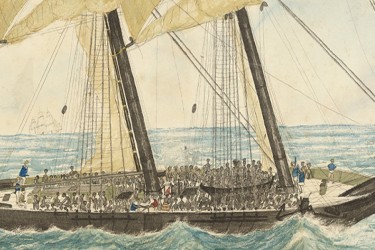
Infection Hot Spot
Watching disease spread and kill on slave ships.
by
Manuel Barcia
via
Lapham’s Quarterly
on
April 22, 2020
The War on Coffee
The history of caffeine and capitalism can get surprisingly heated.
by
Adam Gopnik
via
The New Yorker
on
April 20, 2020
Mark Twain in the Time of Cholera
The disease afflicted the author as he was writing what would become "The Innocents Abroad."
by
Johnny Miller
via
National Review
on
April 16, 2020
“Infection Unperceiv’d, in Many a Place”: The London Plague of 1625, Viewed From Plymouth Rock
In 1625, New England’s “hideous and desolate” isolation suddenly began to seem a God-given blessing in disguise.
by
Peter H. Wood
via
We're History
on
April 15, 2020
How American Samoa Kept a Pandemic at Bay
A story of quarantine.
by
James Stout
via
Lapham’s Quarterly
on
April 2, 2020
How the Black Death Radically Changed the Course of History
A look at the economic changes that occured after the Black Death in Europe and what that could mean for the aftermath of Covid-19.
by
Steve LeVine
via
Medium
on
April 2, 2020
partner
Was Modern Art Really a CIA Psy-Op?
The number of MoMA-CIA crossovers is highly suspicious, to say the least.
by
Lucie Levine
,
Jonathan Harris
,
Christine Sylvester
,
Russell H. Bartley
,
Frank Ninkovich
via
JSTOR Daily
on
April 1, 2020
The Shortages May Be Worse Than the Disease
Over the centuries, societies have shown a long history of making the effects of epidemics worse and furthering their own destruction.
by
Elise A. Mitchell
via
The Atlantic
on
March 11, 2020
Why It Took Congress 40 Years to Pass a Bill Acknowledging the Armenian Genocide
It has little to do with what happened in 1915, and everything to do with Cold War-era geopolitics in the Middle East.
by
Eldad Ben Aharon
via
The Conversation
on
March 6, 2020
Militarize, Destabilize, Deport, Repeat
Plan Colombia functioned like an ideological laboratory for forever war in the twenty-first century.
by
Stephen D. Cohen
via
The Baffler
on
March 5, 2020
partner
Critics of Bernie Sanders’s Trip to the Soviet Union Are Distorting It
Sanders was expressing broadly bipartisan enthusiasm for Soviet reform, not a love of authoritarianism.
by
Artemy M. Kalinovsky
,
Yakov Feygin
,
Yana Skorobogatov
via
Made By History
on
March 2, 2020
The Intelligence Coup of the Century
For decades, the CIA read the encrypted communications of allies and adversaries.
by
Greg Miller
via
Washington Post
on
February 11, 2020
The Vexed History of Zionism and the Left
A new book asks why the left fell out of love with Zionism, but what it reveals is why liberal Zionists fell out of love with the left.
by
Joshua Leifer
via
The Nation
on
February 10, 2020
My Uncle, the Librarian-Spy
In 1943, a Harvard librarian was quietly recruited by the OSS to save the scattered books of Europe.
by
Kathy Peiss
via
CrimeReads
on
February 5, 2020
How the US Repeatedly Failed to Support Reform Movements in Iran
A scholar of social movements in Iran asks why the US has consistently failed to support that country's activist reform movements.
by
Pardis Mahdavi
via
The Conversation
on
February 5, 2020
Day One at Yalta, the Conference That Shaped the World: ‘De Gaulle Thinks He’s Joan of Arc’
A day-by-day account of the historic summit in Yalta, seventy-five years later.
by
Diana Preston
via
Literary Hub
on
February 4, 2020
How Carter's '80 SOTU Unleashed America's 'World Police'
Forty years ago he announced a new American doctrine of aggressive Middle East interventionism that never went away.
by
Edward D. Change
via
The American Conservative
on
February 4, 2020
Our Man: Richard Holbrooke and the End of the American Century
After serving in Vietnam, Richard Holbrooke became a proponent of soft power. He would then contribute greatly to American foreign policy.
by
Samuel Moyn
via
London Review of Books
on
January 27, 2020
The Nazis and the Trawniki Men
Decades after the war, a group of prosecutors and historians discovered the truth about a mysterious SS training camp in occupied Poland.
by
Debbie Cenziper
via
Washington Post Magazine
on
January 23, 2020
Slavery, and American Racism, Were Born in Genocide
Martin Luther King Jr. recognized that Imperial expansion over stolen Indian land shaped and deepened the American Revolution’s relationship to slavery.
by
Greg Grandin
via
The Nation
on
January 20, 2020
The Long War Against Slavery
A new book argues that many seemingly isolated rebellions are better understood as a single protracted struggle.
by
Casey N. Cep
via
The New Yorker
on
January 20, 2020
The ‘Revolution of ’89’ Did Not Initiate a New Era of History
Though significant, the end of the Cold War was not nearly as significant a turning point as President George H.W. Bush suggested it would be in 1990.
by
Andrew J. Bacevich
via
The Nation
on
January 13, 2020
partner
How a Black Female Fashion Designer Laid the Groundwork for Ghana’s ‘Year of Return’
When Ghana gained independence, Freddye Henderson facilitated African American tourism to the new nation.
by
Tiffany M. Gill
via
Made By History
on
January 10, 2020
Rambo Politics from Reagan to Trump
Trump links the assassination of Iranian General Soleimani to the 1979 Iran hostage crisis, positioning himself as Rambo, avenging American humiliation abroad.
by
Bonnie Honig
via
Boston Review
on
January 6, 2020
“The Police Know Guerrilla Warfare”
During the Cold War, cops at home and military personnel abroad exchanged techniques and tactics to mete out repression and thwart leftist insurgencies.
by
Kyle Burke
via
Jacobin
on
December 20, 2019
partner
The Whistleblowers of the My Lai Massacre
Three men who brought the terrors of My Lai to light.
by
Howard Jones
via
HNN
on
December 17, 2019
Previous
Page
24
of 31
Next