Collection

Self-Improvement

In a nation with a mythology that stresses individualism and self-determination, it is no wonder that Americans have tried all sorts of strategies for self-improvement. Turning inward, and adopting particular practices in the service of personal or social transformation, is often an attempt to assert one's own agency. But as the following articles show, our inevitable failures to achieve our goals are often shaped by structural forces beyond our control. The pieces in this collection explore the promises and pitfalls of striving to better one's mind, body, and spirit.
A photograph of Frederick Douglass imposed on the cover of The Columbian Orator by Caleb Bingham.

The Columbian Orator Taught Nineteenth-Century Americans How to Speak

For strivers like Lincoln, guides to rhetoric had a special currency in the nineteenth century.
Two of the most celebrated public speakers in American history, Frederick Douglass and Abraham Lincoln, taught themselves the skills of oratory from a popular textbook.
Longshoremen on their lunch hour at the San Francisco docks.

Jack London, "Martin Eden" and The Liberal Education in US Life

In Jack London’s novel, Martin Eden personifies debates still raging over the role and purpose of education in American life.
In a semi-autobiographical novel, Jack London made the case that reading widely is both gratifying and liberating, but poverty robs people of the time and energy required for such self-education.
Panting of a woman lounging with a book, titled “Dolce far niente” (The Sweetness of Doing Nothing), by Auguste Toulmouche, 1877.

We’re Distracted. That’s Nothing New.

Ever since Thoreau headed to Walden, our attention has been wandering.
In the 19th century and today, Americans have often blamed distraction on the individual, and sought its cure in the disciplined cultivation of attention - but is that a battle we're destined to lose?
Pink tinted photograph of women on the beach lifting barbells

Nevertheless, She Lifted

A new feminist history of women and exercise glosses over the darker side of fitness culture.
The history of women's physical fitness reveals a tension between the pressure to conform to society's beauty ideals and the possibility of feminist resistance through physical strength.
Henry S. Club
partner

Meatless Moralism

Adam Shprintzen discusses the 19th-century Americans who saw a vegetarian diet as a powerful tool of moral reform, one that could even put an end to slavery.
While mid-19th century moral reformers promoted vegetarianism as a tool of social change, the subsequent generation saw it as a tool for personal economic success.
Native American and Black girls tossing around a medicine ball in a circle.

Right Living, Right Acting, and Right Thinking

How Black women used exercise to achieve civic goals in the late nineteenth century.
In response to late 19th-and early 20th-century ideas that one's body revealed one's character, Black women striving for racial uplift used physical fitness to prove their civic fitness.
Green labels read "100% Natural Product" and "Natural Bio Product"

Guilt-Free: Naturopathy and the Moralization of Food

How the rise of alternative, "natural," medicines led Americans to equate food with moral character.
Protein bars, sugar-free cookies, and feelings of guilt in the grocery aisle have origins, in part, in an early 20th-century movement that emphasized individual choice and self-control as the path to health.
The dramatic landscape of Big Sur cliffs and coastline.

Shouldn’t You Be in California?

The western frontiers of national wellness culture.
California's countercultural retreats, feminist clinics, and gym culture sparked a wellness movement in the 1970s that connected the mind and body.
New York Marathon runners on the Verrazano Bridge.

Rat Race

Why are young professionals crazy for marathons?
Across the late 20th century, running has appealed to a range of young people, from counterculture types chasing a physical and spiritual high to yuppies training for marathons to optimize their performance efficiency and enhance their competitive edge.
original

America @ Worship

How social media is – and isn't – changing American religion.
From broadsides to televangelists to social media, Americans have a long history of viewing religion as a "therapeutic culture" and seeking out technologies that deliver prompts for self-care.
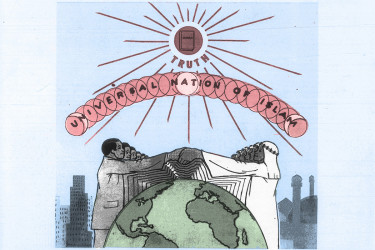
Illustration of Nation of Islam members holding hands with Muslims from the Middle East over globe.
partner

The Nation of Islam's Role in U.S. Prisons

The Nation of Islam is controversial. Its practical purposes for incarcerated people transcend both politics and religion.
In addition to offering spirituality and community, Nation of Islam has a long history of training incarcerated men in methods of peaceful resistance, effective communication, rights advocacy, and healthy living.

How Hobbies Infiltrated American Life

America has a love affair with “productive leisure.”
The industrial-era shift from hobbies being discouraged as unhealthy obsessions to promoted as productive leisure reveals the contradictions inherent in seeking mental escape in the same activities that are manifestations of one's capitalist anxieties.
A collage of book covers.

The Radical Origins of Self-Help Literature

How did the genre of self-help go from one focused on collective empowerment to one serving the class hierarchy as it stands?
How a genre of DIY organizing strategies for working class collectivist mutual aid efforts turned instead to cater to bourgeois anxieties around securing and advancing an individual's social position.
White people in athleisure clothing doing yoga.

Twenty-First Century Victorians

The nineteenth-century bourgeoisie used morality to assert class dominance — something elites still do today.
As in the Victorian era, many of today's upper-middlc-class self-improvement fads are strategies for asserting one's social position, masquerading as the pursuit of individual virtue.
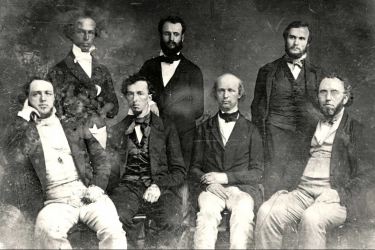
George Ripley, Horace Greeley, and the staff of the New York Tribune

What America’s 19th-Century Reformers and Radicals Missed

The dangers of confusing self-improvement with institutional change.
The struggles and failures the Transcendentalists faced in their efforts of self-improvement and social reform serve as a warning that looking inward for solutions may mask the need for broader structural change.