Filter by:

Filter by published date

Viewing 61–90 of 364 results. Go to first page
For most of her 74 years, Ruth Ann Hills took a certain innocent pride in her family’s story and its place in Staten Island history.  Generations of her family had resided in Mariners Harbor on the island’s North Shore. She and her brother David Thomas live in the house their grandfather built on Van Pelt Avenue. They had found Black ancestors on Staten Island as far back as the 1700s, and incredibly they had all eluded slavery.  Or so Hills thought.   All of that changed one day in 2021, when Hills received a visit from a filmmaker. Heather Quinlan was working on a documentary about a nearby graveyard. Over the course of her genealogical research, Quinlan had discovered that one of the people buried there was Hills’ great-great-great-grandfather.  Neither Hills nor Thomas had ever heard of the man, Benjamin Prine, but his death in 1900 at the age of 106 had been covered by the New York Times and the wire services. Prine, a U.S. veteran of the War of 1812, had been the last enslaved person born on Staten Island, Quinlan told them.  A photograph of a man, seated, holding a cane. The photograph has a long caption beneath, that is headlined "THEY CAN'T TAKE THAT AWAY FROM ME." Hills' and Thomas' great-great-great-grandfather, Benjamin Prine.  Staten Island Historical Society. Prine had once been enslaved by Peter Van Pelt, a highly influential Dutch Reformed Church minister – meaning that the street on which the siblings now live took its name from the same white family that enslaved their ancestor.  “I thought I was a big history buff. ‘Oh, I know about history,’” Hills said. “I guess I was naive.”  A crosswalk scene underneath two large street signs that both read "Van Pelt Av." The intersection of Van Pelt Avenue and Forest Avenue on Staten Island. Reece T. Williams/Gothamist

How the Remains of Formerly Enslaved People Came to Rest Beneath a Staten Island Strip Mall

Benjamin Prine's descendants didn’t know about their family ties – or their connection to his enslaver.
Tourists taking photos at the Martin Luther King Jr. Memorial on the National Mall in Washington, D.C.
partner

Martin Luther King Jr. and the Coca Cola Strategy: Selling King’s Dream to the World

Martin Luther King’s words are available publicly — for a price.
Unionists in East Tennessee Swear Loyalty to the Union Flag in 1862.

Remembering Southern Unionists

Confederate monuments helped to erase the history of those white and black southerners who remained loyal and were willing to give their lives to save the United States.
Company of Black infantry at Fort Lincoln

The Civil War and Natchez U.S. Colored Troops

The Natchez USCT not only contributed to the war effort but was essential to establishing a post-war monument honoring President Lincoln and emancipation.
Brian (Bryan) Farm House, Gettysburg

Walking with Enslaved and Enslavers at Pickett’s Charge (and Retreat)

Today, it’s still nearly impossible to see the Black people whose presence, tramped down for a century and a half, is why this commemorative landscape exists.
Royal Fusiliers War Memorial, 2011. Photograph by Robert Scarth.

Monuments with Mission Creep

On “all wars” memorials.
Photo of the Penn and Slavery Project augmented reality tour

A Bare and Open Truth: The Penn and Slavery Project and the Public

When a university denied its legacy, students and faculty stepped in to do the research.
original

Tidying Up the Past

A history tour at Harper’s Ferry suggests that “commemoration” and “desecration” might be two sides of the same coin.
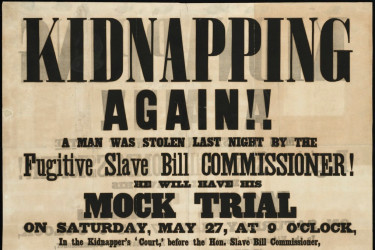
Abolitionist broadside from 1854 calling out the fugitive slave bill commissioner

An Angry Mob Broke Into A Jail Looking For A Black Man—Then Freed Him

How Oct. 1 came to be celebrated as “Jerry Rescue Day” in abolitionist Syracuse.
Photograph of firefighters raising an American flag in the rubble of 9/11.

The Real Story Behind This Iconic 9/11 Photo

How does an image become “iconic?” And when it does, will its meaning change?
Flowers and balloons surround Memorial at Robb Elementary School, Uvalde, Texas.

How Many Pandemic Memorials Does it Take to Remember a Pandemic?

Calls for Covid-19 memorials echo Pericles' Athenian moratorium, prompting reflection on the appropriateness of commemoration for ongoing crises.
Erick Cedeño on a bicycle and map of a route through the west.

Following the Black Soldiers who Biked Across America

Bikepacking historian Erick Cedeño retraces the Buffalo soldiers' legendary journey from Montana to Missouri to rethink it and its place in American history.
Mural featuring Texas Rangers, longhorn cattle, and bluebonnets.

The Real Meaning of Texas Ranger Monuments

In recent years, Seguin has honored the Texas Rangers with memorials. My father agreed to build one—but then started having second thoughts.

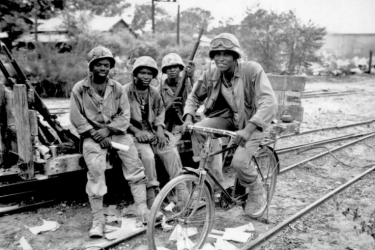
Black Marines Were 'Dogged' On This Base In The 1940s. Now They're Honored There

In the 1940s about 20,000 men trained on racially segregated Montford Point in North Carolina.
Monument to Confederate War Dead in Hollywood Cemetery

Hollywood Cemetery: The Treatment of Post-War Confederate Dead

While cemeteries are tributes to the dead, they are really about the living. They are about those who want to commemorate something.
Rally honoring Martin Luther King Jr., Central Park, New York City, 1968

A Case of the Mondays

The beginning of the fight for Martin Luther King Jr. Day.
Black and white photo of Women's Overseas Service League Members
partner

"Our Best Memorial to the Dead Would be Our Service to the Living"

By learning about an overlooked cohort of women who served in World War I, we can expand our understandings of memorials beyond physical statues and monuments.
Crowd gathers at the Memorial Amphitheater, circa 1920-1950.

Flowers of Remembrance Day: Inaugurating a New Tradition at Arlington National Cemetery

Decorating graves with flowers, from a Civil War grassroots ritual of remembrance to a national tradition honoring all military dead.
original

History on the Road

After decades of reading, writing, and teaching about the American past, Ed Ayers sets out to see how that past is remembered in the places where it happened.
Mushroom cloud of nuclear bomb.

Forgetting the Apocalypse

Why our nuclear fears faded – and why that’s dangerous.
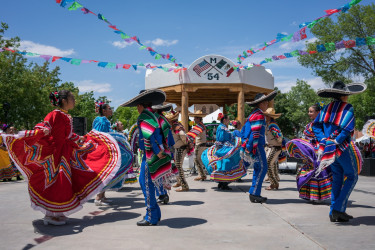
Ballet Folklorico de la Tierra del Encanto dancers entertain attendees during the Cinco De Mayo Fiesta on the plaza in Mesilla, N.M., on May 6, 2017.
partner

Cinco De Mayo: American As Apple Empanadas

Cinco de Mayo has deep roots in Mexican American history.
Brooklyn Dodgers infielder Jackie Robinson in uniform, circa 1945.

Jackie Robinson’s Last Fight

As baseball celebrates the 75th anniversary of Robinson’s breaking the color line, it’s worth remembering a man at odds with his own myth.
Sheet music cover for Civil War marching song "The Bonnie Blue Flag," featuring two flags used by Confederate states.

We Are a Band of Brothers

Why are so many songs of the Confederacy indelibly inscribed in my Yankee memory?
A book labeled "history" begin painted white to represent revisionism.

Right-Wing Nationalists Are Marching into the Future by Rewriting the Past

Fights over history like those in the U.S. are happening all over the world.
This 1925 painting depicts an idealized version of an early Thanksgiving celebration in Plymouth.

How to Tell the Thanksgiving Story on Its 400th Anniversary

Scholars are unraveling the myths surrounding the 1621 feast, which found the Pilgrims and the Wampanoag cementing a newly established alliance.
Major Charles Whittlesey in his military uniform.

A Tragedy After the Unknown’s Funeral: Charles Whittlesey and the Costs of Heroism

While he did not die in a war, he can certainly be mourned as a casualty of war—as can the thousands of other veterans who have died by suicide.
An unkempt cemetery

When Black History Is Unearthed, Who Gets to Speak for the Dead?

Efforts to rescue African American burial grounds and remains have exposed deep conflicts over inheritance and representation.
A 9/11 memorial

Relic Steel

After 9/11, hundreds of pieces of steel debris were catalouged. Much of it ended up in small municipal memorials and in other locations around the country.

What Made the Battle of Blair Mountain the Largest Labor Uprising in American History

Its legacy lives on today in the struggles faced by modern miners seeking workers' rights.
An effigy of Richard Nixon with a distorted papier-mache head.

The People’s Bicentennial Commission and the Spirit of (19)76

The Left once tried to own the legacy of America’s Bicentennial, but ran into ideological and structural roadblocks all too familiar today.

Filter Results:

Suggested Filters:

Idea

Person