Person

John Brown

Related Excerpts

original

Tidying Up the Past

A history tour at Harper’s Ferry suggests that “commemoration” and “desecration” might be two sides of the same coin.
1928 painting of a girl getting baptized in a pool, surrounded by a crowd on a farm.

Trouble in River City

Two recent books examine the idea of the Midwest as a haven for white supremacy and patriarchy.
U.S. Supreme Court building, Washington, D.C.

"A Man of His Time": From Patrick Henry to Samuel Alito in U.S. History

The struggle for progress is always two steps forward and at least one step back.
Workers working on ruins after the US Civil War, circa 1865.

The Abolitionist Legacy of the Civil War Belongs to the Left

The US Civil War was a revolutionary upheaval that crushed slavery and stoked hopes of a broader emancipation against the rule of property.
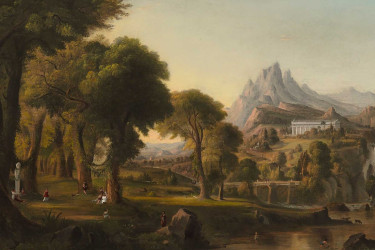
Pastoral landscape with classical architecture. Copy after Thomas Cole’s “Dream of Arcadia”, by Robert Seldon Duncanson, 1852.

An Ugly Preeminence

On the devout abolitionists who excoriated American exceptionalism.

Battle Hymn of the Republic and the Apotheosis of Washington

What a video of an Jan. 6 insurrectionist illustrates about race, religion, and nationalism in the MAGA movement.
Painting of Lincoln and his cabinet by M.S. Carpenter, 1863.

Did the Constitution Pave the Way to Emancipation?

In his new book, "The Crooked Path to Abolition," James Oakes argues that the Constitution was an antislavery document.
Left: Longfellow in His Study, by Worth Brehm, c. 1912. Cooper Hewitt, Smithsonian Design Museum. Right: Dante Meditating on “The Divine Comedy”, by Jean-Jacques Feuchère, 1843.

As Far From Heaven as Possible

How Henry Wadsworth Longfellow interpreted Reconstruction by translating Dante.
Carrie Nation

Carrie Nation Spent the Last Decade of Her Life Violently Destroying Bars. She Had Her Reasons. 

Nobody was listening, so she brought some rocks.
Jim Jones and family

In the Image of Jonestown

In our flattened historical imagination, pictures of atrocity and those of progress can coincide in unsettling ways.
A newspaper drawing of the Nat Turner Rebellion.

Looking for Nat Turner

A new creative history comes closer than ever to giving us access to Turner’s visionary life.

The Unreconstructed Radical

Thaddeus Stevens was a fierce opponent of the “odious” compromises in the Constitution, and of the North’s compromises after the Civil War.
Abraham Lincoln

Lincoln’s Rowdy America

A new biography details the cultural jumble of literature, dirty jokes, and everything in between that went into the making of the foremost self-made American.
Illustration of James McCune Smith, the African Free School #2, and the University of Glasgow

America's First Black Physician Sought to Heal a Nation's Persistent Illness

An activist, writer, doctor and intellectual, James McCune Smith, born enslaved, directed his talents to the eradication of slavery.
African American men who escaped slavery at a US Army Camp.

John Wolcott Phelps’ Emancipation Proclamation

The story of John Wolcott Phelps and his push for Lincoln to emancipate all slaves.
Carolers walking and carrying sheet music
partner

The Forgotten Civil War History of Two of Our Favorite Christmas Carols

Over time, the historic roots of some holiday music have been forgotten.
Erie Canal historical marker

The ‘Psychic Highway’ that Carried the Puritans’ Social Crusade Westward

Elements of the Puritans’ unique worldview were handed down for generations and were carried westward by their descendants, the people we call Yankees.
Massacre in Boston

Knives Out

‘Struggle: From the History of the American People’ charts the strife of early US history in a fierce Cubist/Expressionist style.
Abraham Lincoln

Why We Keep Reinventing Abraham Lincoln

Revisionist biographers have given us countless perspectives, from Honest Abe to Killer Lincoln. Is there a version that’s true to his time and attuned to ours?

The Revolutionary Thoreau

Generations of readers have chosen to emphasize Thoreau's spiritual communion with Nature, but Walden begins with trenchant critique of “progress.”