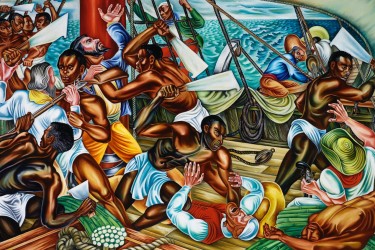
Painting of a mutiny aboard a ship.

Reading Melville in Post-9/11 America

The author's half-forgotten masterpiece, Benito Cereno, provides fascinating insight into issues of slavery, freedom, individualism—and Islamophobia.
Linda Taylor walks out of a courtroom with her attorney.

The Real Story of Linda Taylor, America’s Original Welfare Queen

In the 1970s, Ronald Reagan villainized a Chicago woman for bilking the government. Her other sins were far worse.
partner

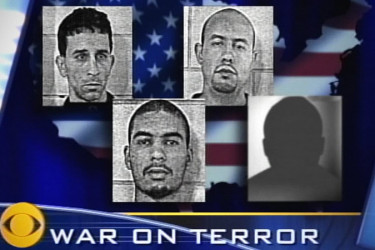
Wrongly Accused of Terrorism: The Sleeper Cell That Wasn't

Six days after 9/11, the FBI raided a Detroit sleeper cell. But, despite a celebrated conviction, there was one problem — they’d gotten it wrong.

The Perfect Wife

How Edith Windsor fell in love, got married, and won a landmark case for gay marriage.

Ruth Bader Ginsburg and Footnote Four

Justice Ruth Bader Ginsburg's solo dissent from an affirmative action case was inspired by a footnote.
partner

Fierce Urgency of Now

Exploring the origins and impacts of the "March on Washington for Jobs and Freedom," on that event's 50th anniversary.

The Court & the Right to Vote: A Dissent

How the Supreme Court got it wrong.
Baby sleeping in a woman's arms.
partner

What’s the Definition of “Person”?

Two court cases that defined and changed the nature of personhood.

Activism in the US

The Civil Rights movement led the way, soon followed by anti-war protests and activism for women’s issues and gay rights.
Ruth Bader Ginsburg sitting on a chair in a room with a fireplace

How Ruth Bader Ginsburg Has Moved the Supreme Court

Despite her path-braking work as a litigator before the Court, she doesn't believe that large-scale social change should come from the courts.

SNCC Digital Gateway

A documentary website that tells the story of how young activists united with local people in the Deep South to build a grassroots movement that transformed the nation.
Thaddeus Stevens imagined as a boxer.

Remarkable Radical: Thaddeus Stevens

Thaddeus Stevens was a fearsome reformer who never backed down from a fight.
Angry mob in Manhattan
partner

The Day Wall Street Exploded

On the spectacular act of terrorism that took place in Manhattan a century ago.

May Day's Radical History

The date of Occupy's strike has ties to the eight-hour day movement, immigrant workers and American anarchism.

Battleground America

One nation, under the gun.
Angela Davis.

An Angela Davis Interview

On revolution and violence.

The Caging of America

Why do we lock up so many people?

March of the Bonus Army

In 1932, twenty-thousand unemployed WWI veterans descended on Washington, DC to demand better treatment from the federal government.
John Ridge

Cherokee Slaveholders and Radical Abolitionists

An unlikely alliance in antebellum America.

Objection

Clarence Darrow’s unfinished work.

How The 'Pox' Epidemic Changed Vaccination Rules

During the 1898-1904 pox epidemic, public health officials and policemen forced thousands of Americans to be vaccinated against their will.
Lithograph of the 1871 massacre of Chinese workers in California.

How Los Angeles Covered Up the Massacre of 17 Chinese

The greatest unsolved murders in Los Angeles' history, bloodier than the Black Dahlia, more vicious than the hit on Bugsy Siegel, occurred on a night in 1871.

On the Death Sentence

David Garland makes a powerful argument that will persuade many readers that the death penalty is unwise and unjustified.

Restarting the Civil Rights Movement

Is there still a civil rights movement?

Their Own Talking

Reconsidering Septima Clark’s life challenges many of our ideas about the Civil Rights Movement and women's roles in it.
Black marchers picket in front of the White House to ask FDR to free the Scottsboro boys.

How 'Communism' Brought Racial Equality to the South

The Communist Party fought for racial equality in the South, specifically Alabama, where segregation was most oppressive.
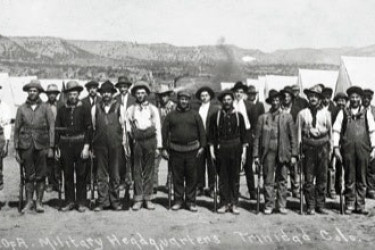
Armed miners at the military headquarters of the United Mine Workers, in Trinidad, Colorado, the month of the Ludlow massacre.

There Was Blood

The Ludlow massacre revisited.
Los Angeles Times building, after being bombed on October 1, 1910

How They Blew Up the L.A. Times

During the half-century between Lincoln and Woodrow Wilson, class warfare in the United States was always robust, usually ferocious, and often homicidal.
Black residents viewing the remains of their burned homes after rioting.

The Day Lincoln's Hometown Erupted In Racial Hate

A century ago, Springfield, Illinois, descended into a two-day spasm of racial violence and mayhem that still has the power to shock.

Dead or Alive: Originalism as Popular Constitutionalism in Heller

Was the 2008 Heller decision a victory for originalism or a living Constitution?